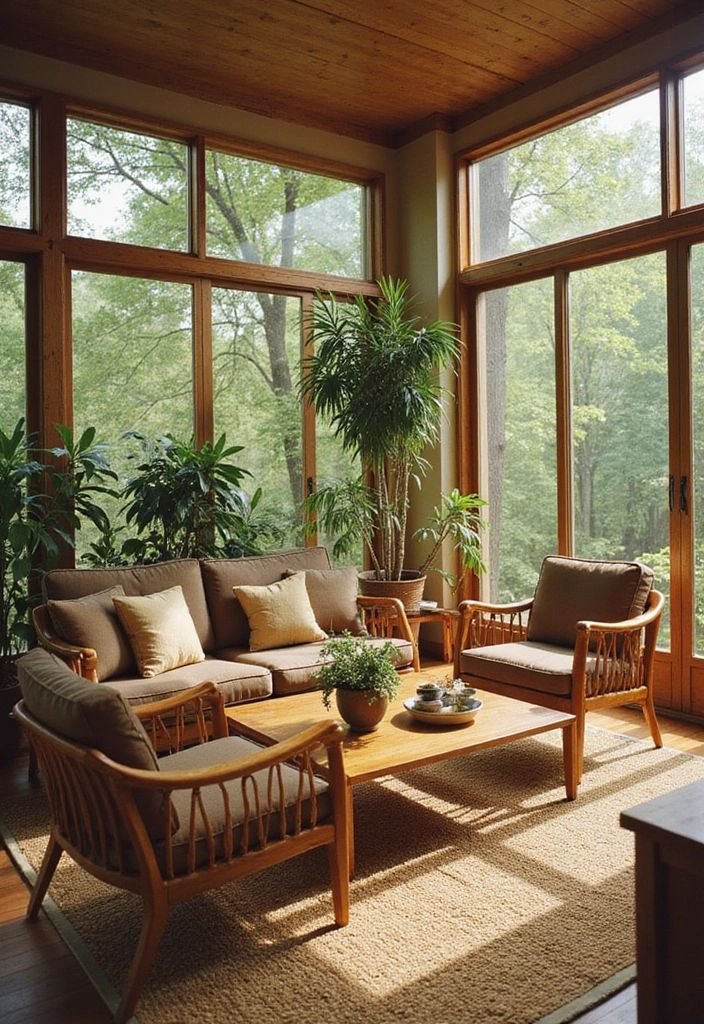
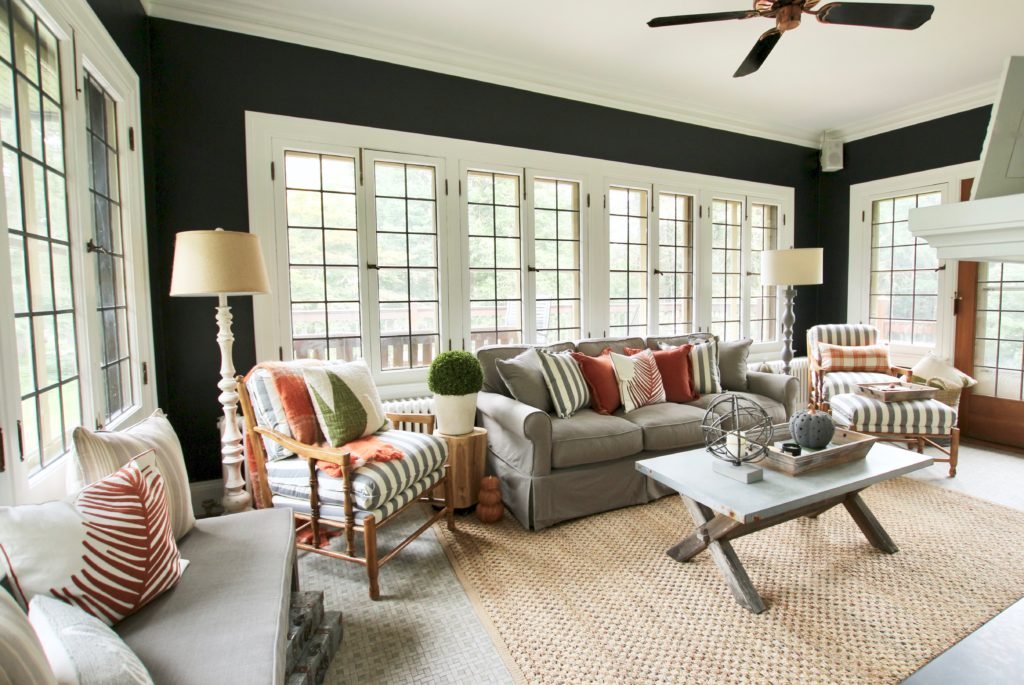
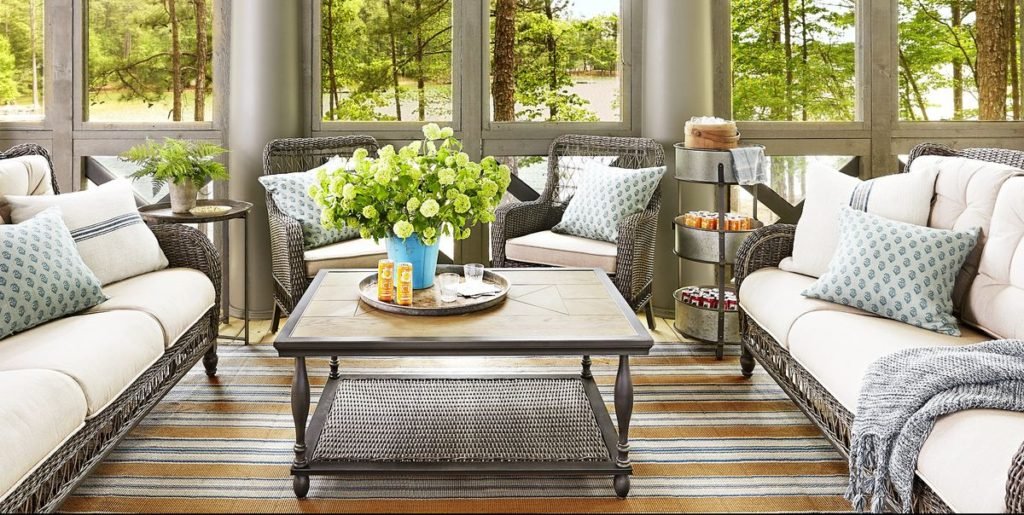
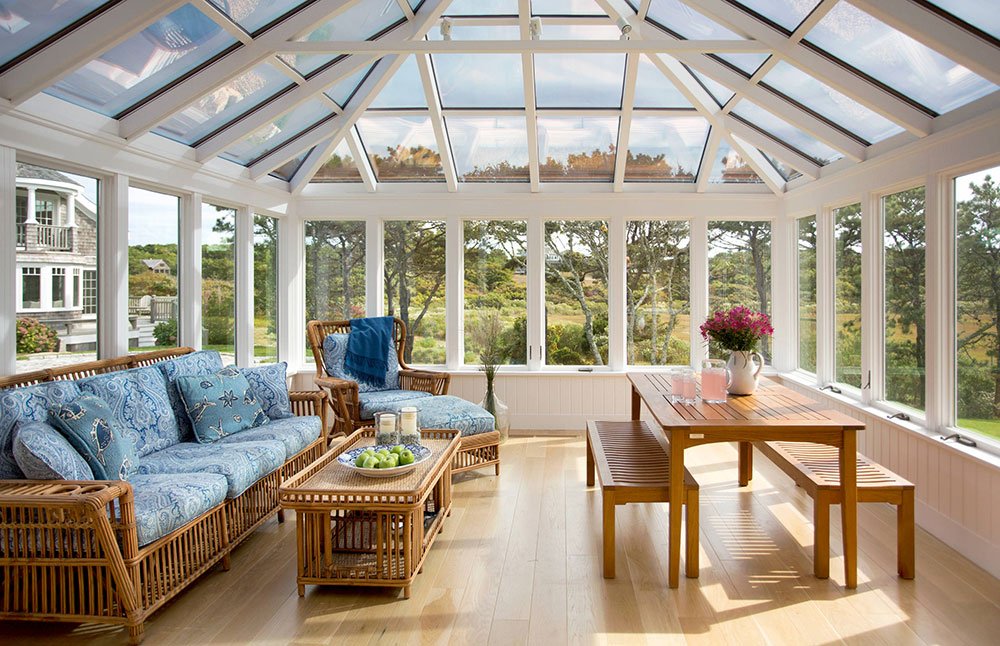
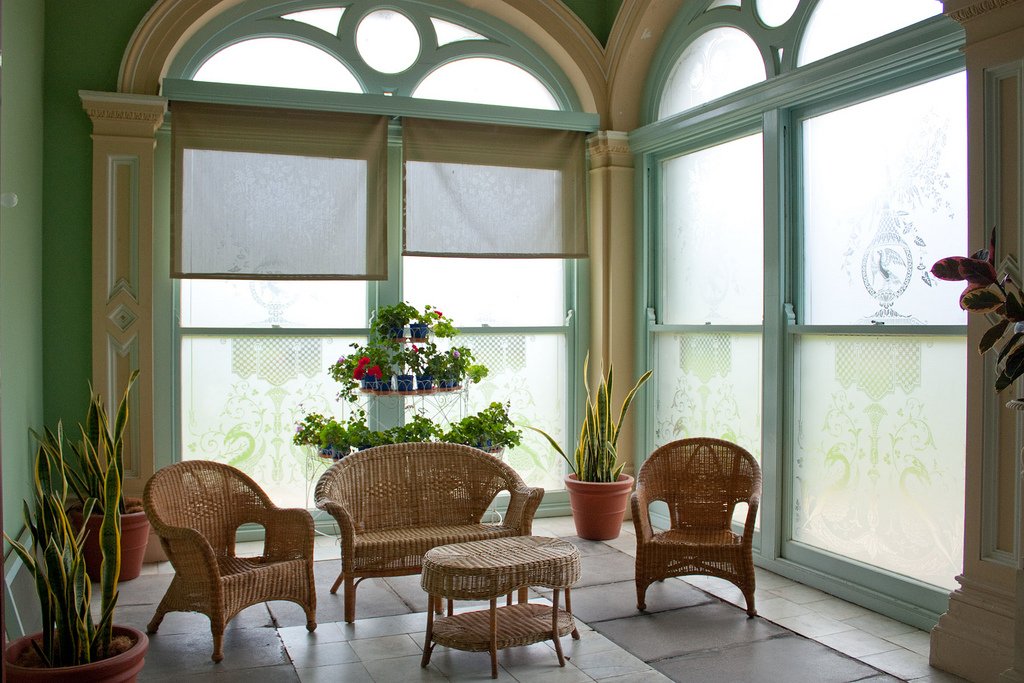
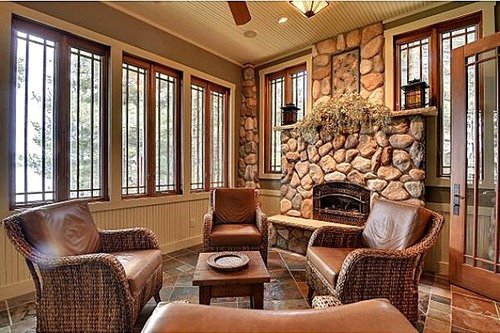
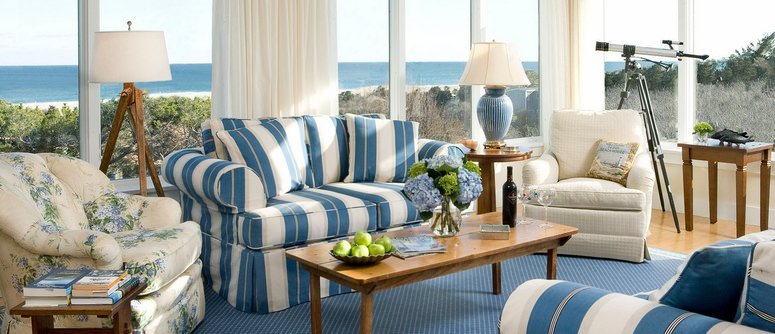
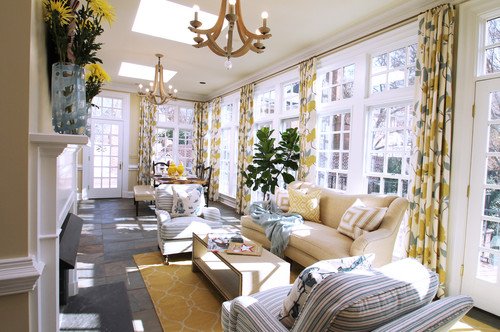
Category: sunroom furniture

  • Sunroom: The Complete Guide to Design, Windows, Insulation & Furniture

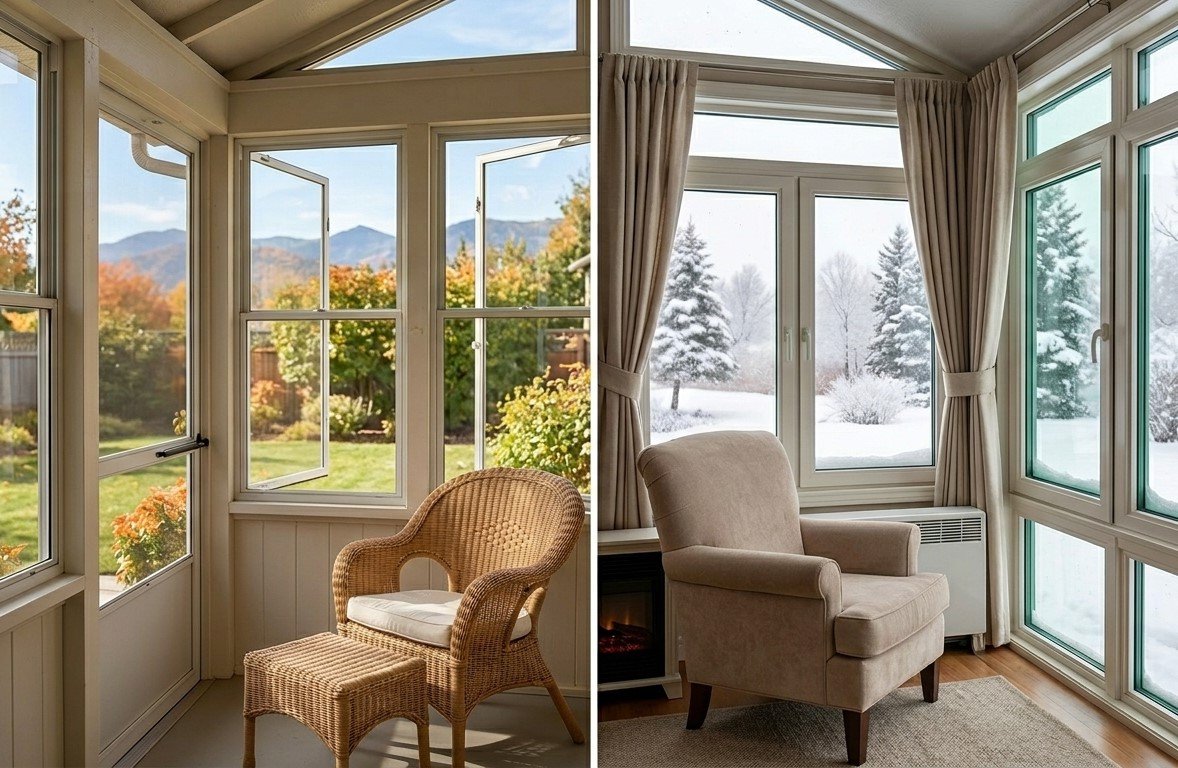
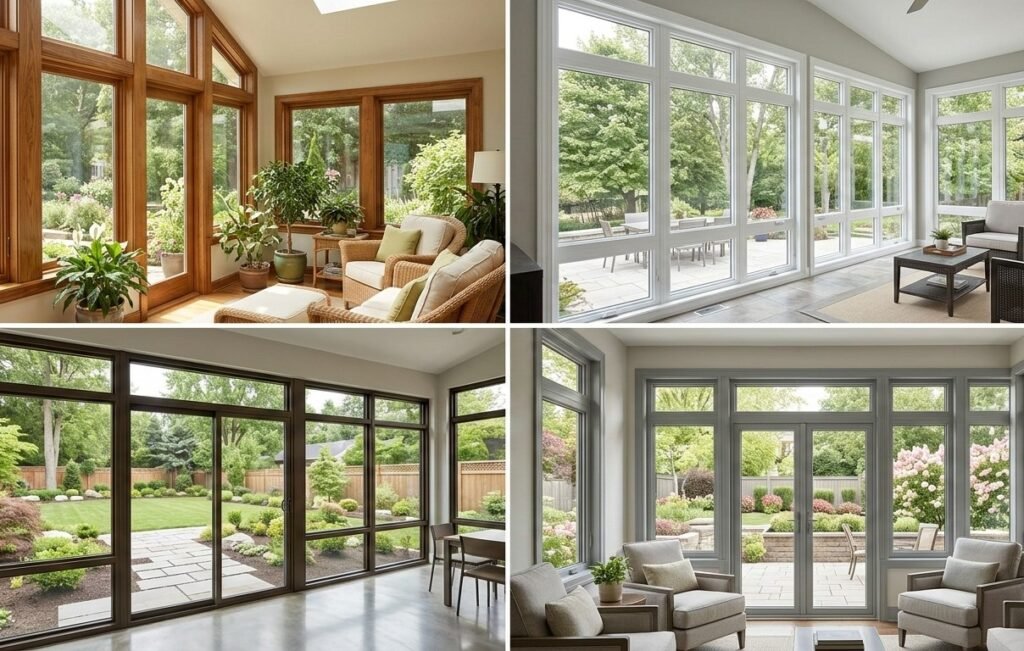
    A sunroom is a glass-enclosed living space designed to maximize natural light while managing seasonal temperature changes. Depending on insulation, windows, and HVAC integration, it can function as a 3-season room or a fully climate-controlled 4-season extension of your home.

    What is a sunroom and how is it different from a regular room?

    A sunroom is defined by glass dominance.

    Unlike a standard room with insulated walls and limited windows, a sunroom contains large expanses of glazing. This creates unique performance challenges:

    • Higher solar heat gain
    • Greater heat loss potential
    • Increased condensation risk
    • More exposure to UV radiation

    A sunroom is not simply an extension. It is an environmental system.

    What Is a Sunroom in Simple Terms?

    A sunroom is a glass-enclosed living space designed to maximize natural light while controlling temperature through insulation, glazing performance, and ventilation. It can be built as a 3-season room for mild weather or a fully insulated 4-season extension usable year-round.

    What Determines Whether a Sunroom Is Comfortable?

    Comfort depends on climate alignment. Glass U-factor controls winter heat loss, SHGC controls summer heat gain, insulation stabilizes temperature swings, and ventilation prevents condensation. Orientation and regional weather patterns are the most important design inputs.

    Is a Sunroom Worth the Investment?

    A properly engineered 4-season sunroom can increase usable space, improve property appeal, and reduce seasonal heating load when aligned with climate and orientation. Poorly specified sunrooms often suffer from overheating, condensation, and higher energy costs.


    How Do You Choose the Right Sunroom Type?

    (5-Step Decision Path)
    sunroom

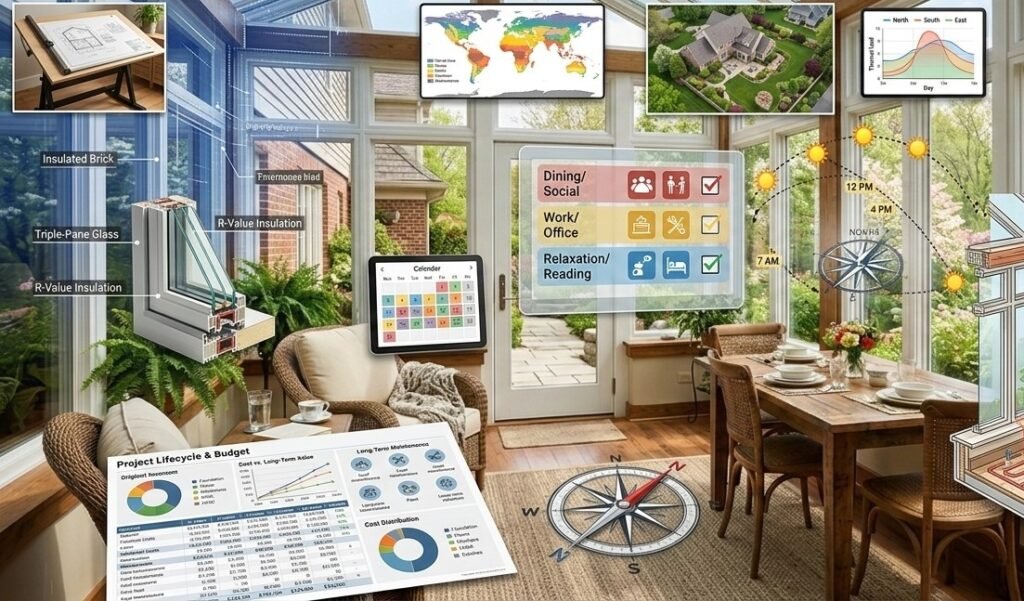
    If you follow these five steps in order, you eliminate 80 percent of common mistakes.

    Step 1 — Define Climate Zone

    Cold = prioritize U-factor
    Hot = prioritize SHGC
    Humid = prioritize ventilation + mold resistance
    Mixed = balance both metrics

    Climate defines glass. Not aesthetics.

    Step 2 — Determine Usage Pattern

    Occasional seasonal use → 3-season
    Daily year-round living space → 4-season
    Architectural feature + aesthetic focus → Conservatory

    Usage defines insulation level.

    Step 3 — Analyze Orientation

    South-facing → passive solar opportunity
    West-facing → overheating risk
    North-facing → heat loss focus

    Orientation modifies glazing selection.

    Step 4 — Decide HVAC Strategy

    No HVAC → seasonal limitations
    Mini-split → flexible and efficient
    Extend central HVAC → integrated but load-sensitive

    HVAC decision determines usability.

    Step 5 — Align Budget With Lifecycle

    Lower upfront cost = higher long-term operating cost
    Higher glazing spec = longer comfort stability

    Think 15 years, not 2.


    What are the different types of sunrooms?
    sunroom

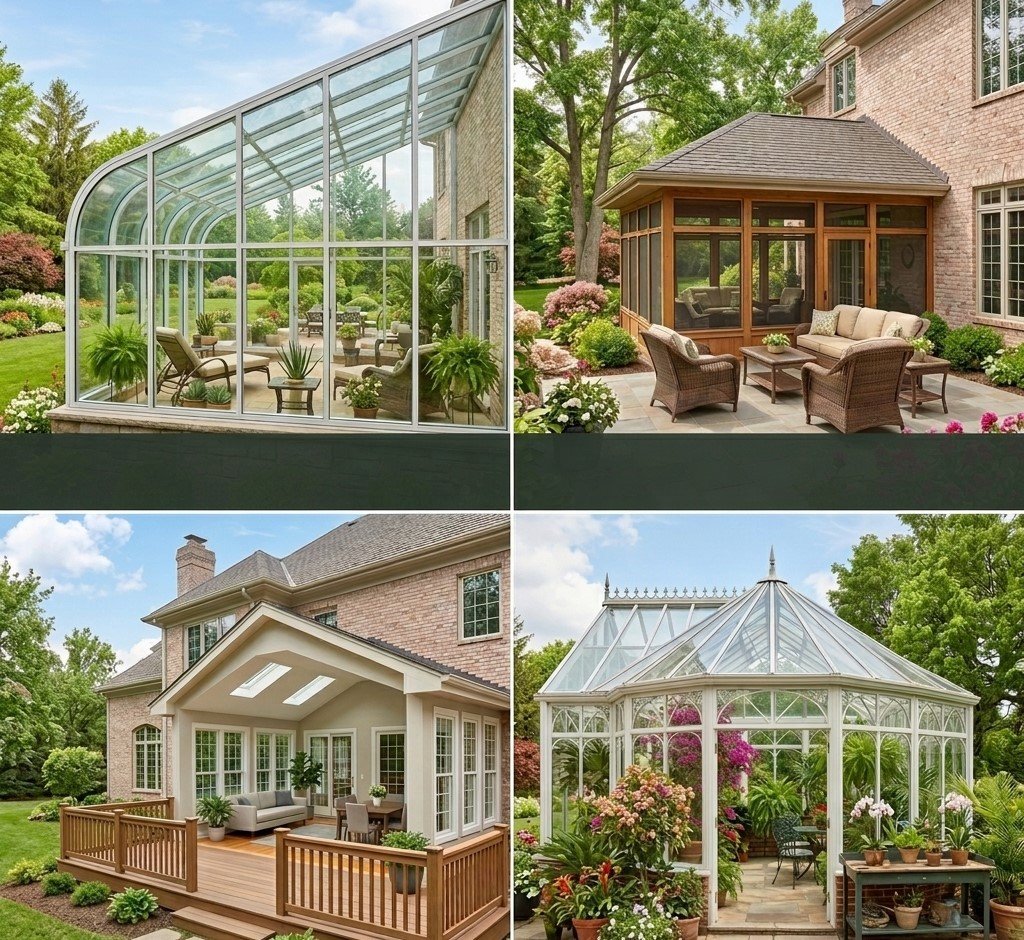
    Sunrooms are classified by insulation level and seasonal usability.

    3-Season Sunroom

    Designed for spring, summer, and fall use. Typically features lighter insulation and basic glazing. Not intended for freezing climates.

    4-Season Sunroom

    Built with insulated glass, energy-efficient frames, and often integrated with home HVAC. Usable year-round.

    Conservatory

    Architecturally ornate sunroom with full glass walls and often glass roofing.

    Enclosed Patio / Florida Room

    Usually a converted patio space with screened or glass enclosure.

    Each type has different material and energy requirements.

    How do sunroom windows impact comfort and energy performance?

    Sunroom windows control heat transfer more than any other element.

    Key metrics:
    • U-factor (heat loss rate)
    • SHGC (solar heat gain)
    • Visible transmittance
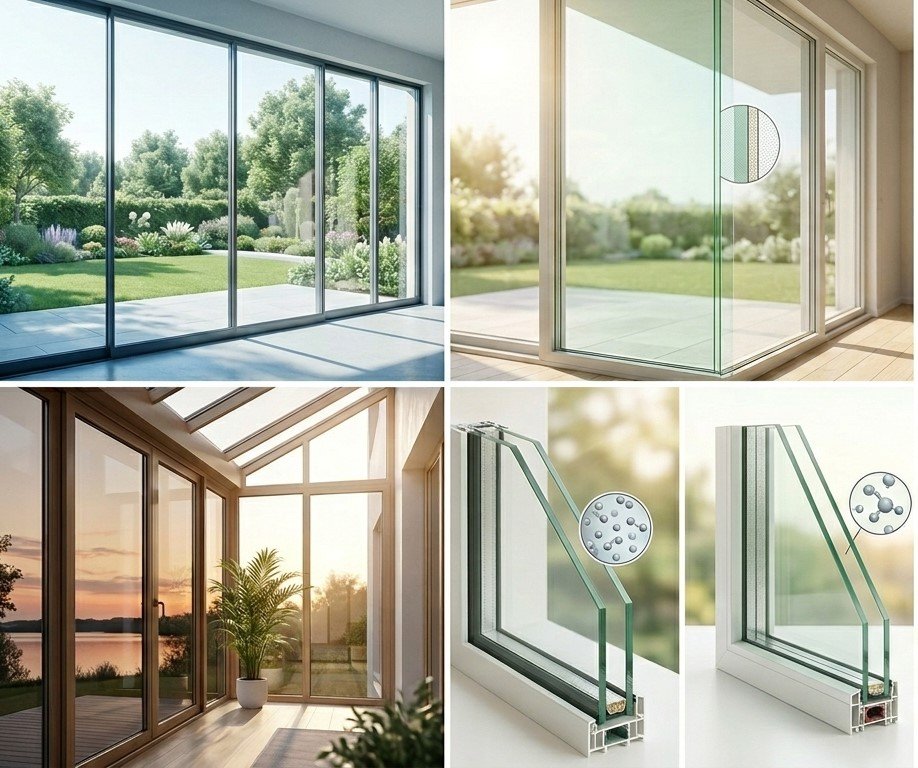
    • Gas fill and spacer systems

    In cold climates, low U-factor reduces winter heat loss.
    In hot climates, low SHGC prevents overheating.

    Glass selection defines comfort. For detailed U-factor and SHGC recommendations by climate zone, see the full Sunroom Windows guide.

    How does insulation affect sunroom usability?

    Insulation determines whether a sunroom is seasonal or year-round. Proper sunroom insulation determines whether the space can function year-round or only seasonally. It directly affects temperature stability, energy efficiency, and condensation control. Sunroom insulation plays a critical role in overall sunroom performance.

    Explore our detailed sunroom insulation guide to understand the best materials, costs, and climate-specific strategies.

    Critical insulation areas:
    • Floor system
    • Roof panels
    • Wall framing
    • Window seals

    Without proper insulation, temperature swings become extreme.

    4-season sunrooms require envelope performance close to main house standards.


    How should heating and cooling be handled in a sunroom?
    sunroom

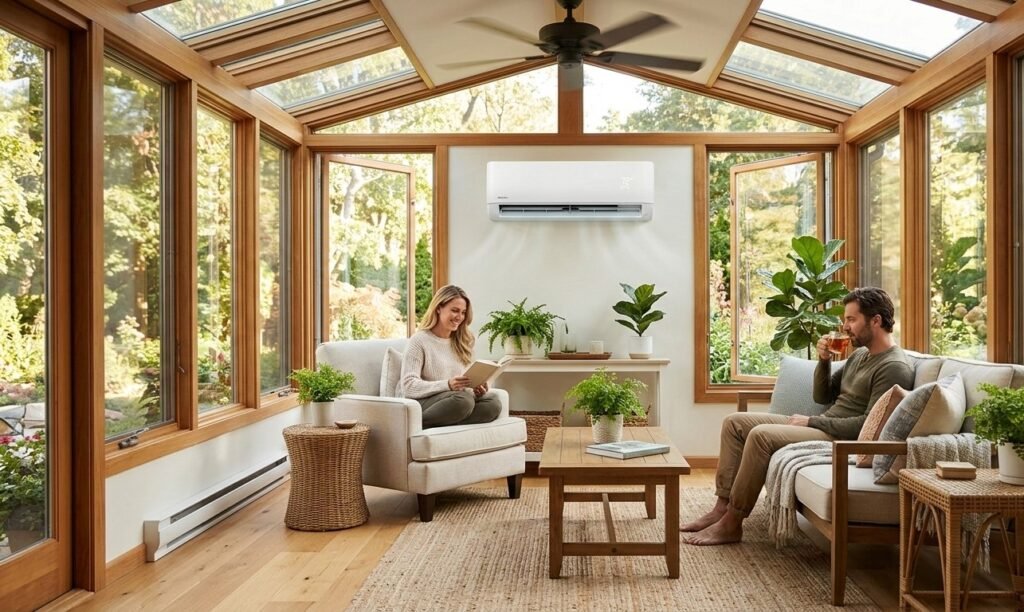
    Sunrooms amplify both heat gain and heat loss.

    Heating options:
    • Extending central HVAC
    • Mini-split systems
    • Electric baseboard
    • Radiant floor heating
    Cooling strategies:
    • Ventilation
    • Ceiling fans
    • Mini-splits
    • Exterior shading

    HVAC load calculations must account for glazing ratio.

    Want to be an expert in the know-hows of Sunroom Heating and Cooling, check out our expert guide

    What flooring works best in a sunroom?

    Flooring must tolerate UV exposure and temperature shifts.

    Best options:
    • Porcelain tile
    • Luxury vinyl plank (UV-resistant grade)
    • Engineered hardwood
    • Sealed concrete

    Natural hardwood may expand and contract excessively under high sunlight.

    What furniture works in a sunroom?

    Furniture must tolerate high light and moderate humidity variation.

    Key considerations:
    • UV-resistant fabrics
    • Mold-resistant cushions
    • Stable frame materials
    • Fade-resistant upholstery

    Indoor furniture may deteriorate quickly without protective glazing.

    For performance-level detail, see:
    → Sunroom Furniture Guide (internal link)

    How does climate affect sunroom design?

    Climate dictates specifications.

    Cold climates require:
    • Insulated glazing
    • Lower U-factor
    • Strong condensation control
    Hot climates require:
    • Solar control glass
    • Lower SHGC
    • Strong ventilation
    Humid climates require:
    • Mold-resistant materials
    • Airflow design
    • Moisture-tolerant furnishings

    Climate mismatch causes most sunroom dissatisfaction.


    What orientation is best for a sunroom?
    sunroom

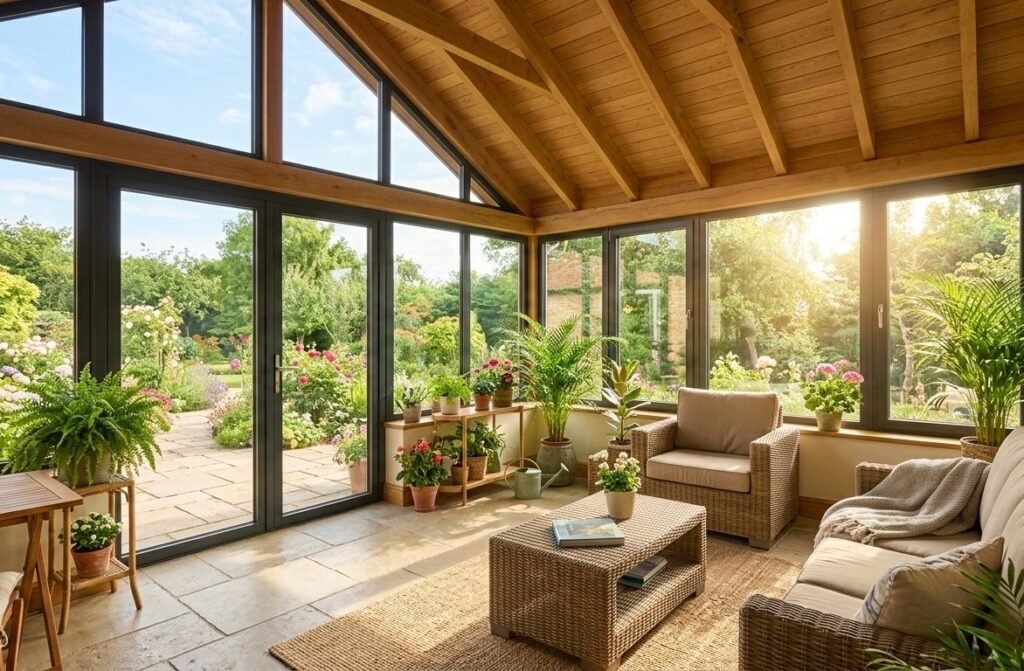
    Orientation determines solar load.

    South-facing:
    • Strong winter gain
    • Summer overheating risk
    West-facing:
    • Afternoon heat spike
    North-facing:
    • Lower solar gain
    • Higher heat loss risk

    Orientation should influence glazing selection more than style preferences.

    What are the most common sunroom problems?

    • Overheating in summer
    • Condensation in winter
    • UV fading of furnishings
    • Seal failure in windows
    • HVAC imbalance

    Most problems result from mismatched specifications.

    How much does it cost to build a sunroom?

    Costs vary widely by type.

    3-season sunroom:
    $8,000–$20,000+

    4-season insulated sunroom:
    $20,000–$50,000+

    Custom conservatories can exceed these ranges significantly.

    Major cost drivers:
    • Glass performance level
    • Structural integration
    • HVAC expansion
    • Permits

    Are sunrooms worth the investment?

    Value depends on build quality.

    A properly insulated 4-season sunroom:

    • Increases usable square footage
    • Improves property appeal
    • Enhances natural light
    • Provides year-round relaxation space

    A poorly specified sunroom becomes underused space. Performance alignment determines ROI.

    Sunroom System Summary

    A successful sunroom balances:

    • Glass performance
    • Insulation
    • Ventilation
    • Climate control
    • Material durability

    It is not a decor project. It is a thermal and environmental design project.

    Sunroom in 10 Practical Rules

    1. Match glazing to climate
    2. Consider orientation before design
    3. Plan ventilation intentionally
    4. Insulate floors and roof properly
    5. Budget for HVAC integration in 4-season rooms
    6. Choose UV-resistant furnishings
    7. Expect seal lifespan of 15–20 years
    8. Verify building code requirements
    9. Design for condensation control
    10. Think lifecycle, not just upfront cost

    Sunroom as an Environmental System (Advanced Concept Layer)

    A sunroom is not a room with extra windows.

    It is a hybrid environmental chamber where:

    • Solar radiation enters freely
    • Heat escapes more easily than in standard walls
    • Humidity levels fluctuate
    • Surface temperatures change faster
    • UV exposure increases material stress

    Think of it as a semi-controlled greenhouse attached to a house.

    The difference between a comfortable sunroom and an unusable one is whether the design acknowledges this.

    Thermal Physics of a Sunroom

    Understanding sunroom performance requires basic heat transfer awareness.

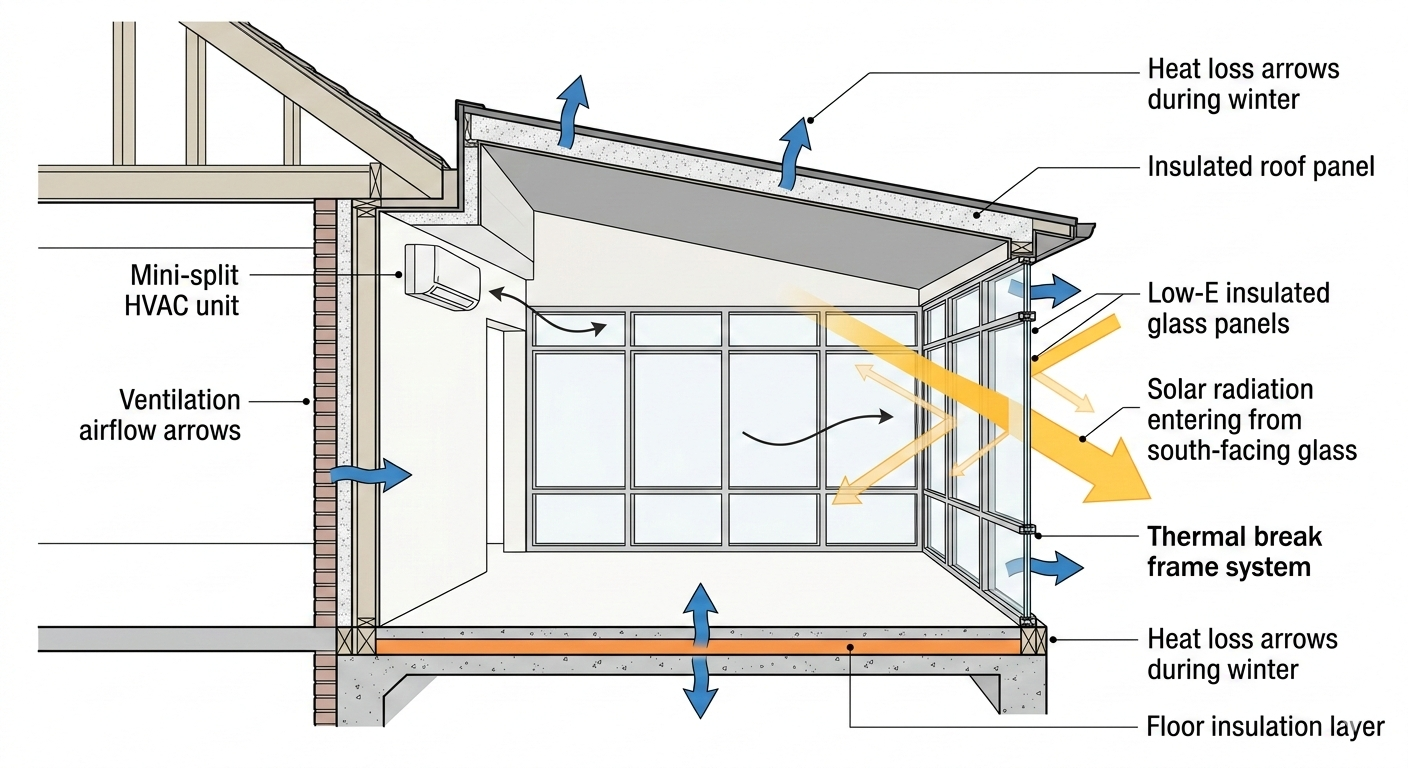
    There are three forms of heat transfer:
    1. Conduction — heat passing through glass and frames
    2. Radiation — solar energy entering through glazing
    3. Convection — air movement within the room

    Because glass conducts heat more than insulated walls, conduction losses are higher in winter.

    Because glass allows radiation, solar gain is amplified in summer. This duality makes sunrooms highly climate-sensitive. To understand more about Sunroom thermal performace, we urge you to check out our metrics about insulating a sunroom for best optimal choices. Among all structural elements, insulation has the greatest impact on whether a sunroom performs as a true four-season living space.

    Detailed Climate Modeling by Region

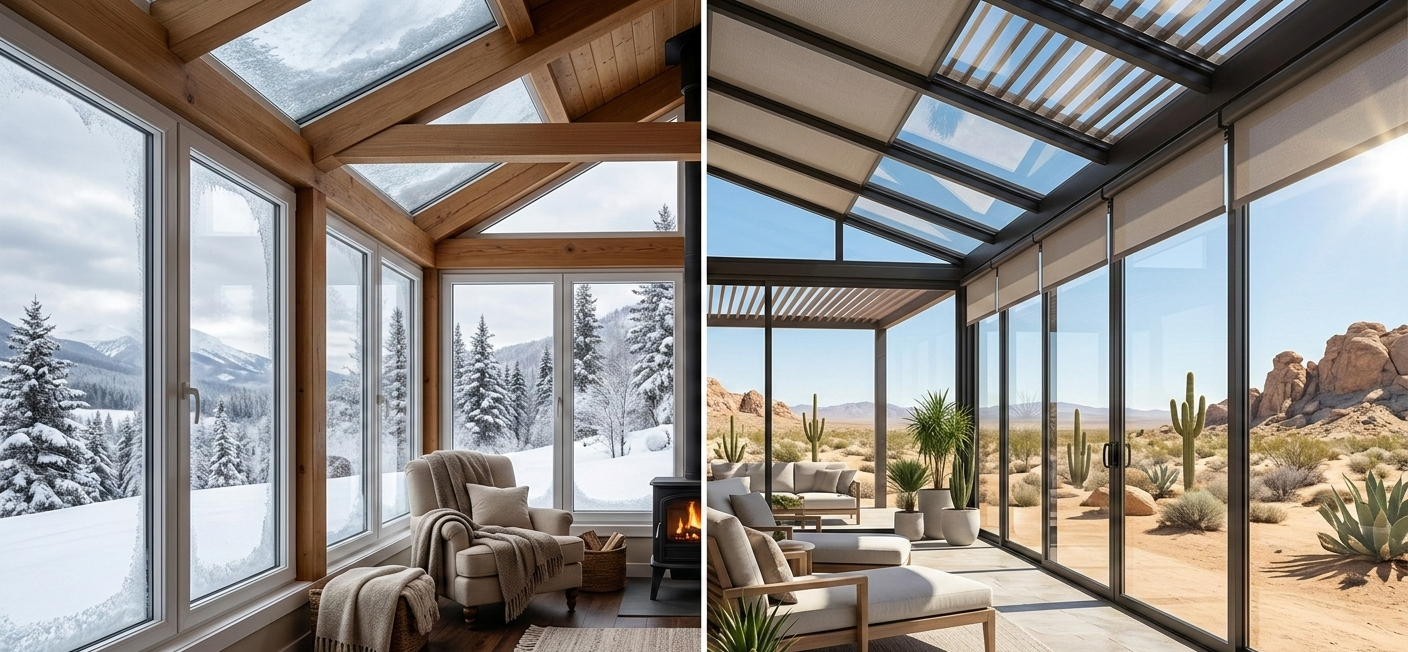
    Cold Northern Climates (Canada, Northern Europe, Northern US)

    Winter temperatures can drop well below freezing.

    Key design focus:
    • Low U-factor glazing
    • Triple-pane in extreme regions
    • Insulated frames
    • Floor insulation
    • Thermal breaks in aluminum

    Condensation becomes the primary risk.

    Interior humidity must be controlled. Without proper insulation, frost may form at glass edges.

    A properly designed cold-climate sunroom can capture passive solar heat on sunny winter days, reducing heating load.

    But if glazing is mismatched, heating bills increase significantly. Check out U-factor and SHGC recommendations for sunrooms in our sunroom windows guide.

    Hot Desert Climates (Arizona, Middle East, Australia)

    Sunrooms here risk becoming solar ovens.

    Design focus:
    • Very low SHGC
    • Solar control Low-E coatings
    • Exterior shading structures
    • Ventilation planning

    West-facing glass must be minimized or heavily shaded.

    In extreme heat, mechanical cooling may be mandatory even for short-term use.

    Thermal comfort becomes the priority over insulation.

    Humid Coastal Regions (Florida, Southeast Asia)

    Humidity fluctuates heavily.

    Design focus:
    • Mold-resistant materials
    • Corrosion-resistant hardware
    • Balanced ventilation
    • Condensation control

    Salt air accelerates corrosion in metal frames.

    Furniture and flooring choices must account for long-term humidity exposure. Moisture accumulation behind walls or under flooring can cause hidden damage.

    Mixed Climate Regions (UK, Midwest US, Central Europe)

    These climates require balanced specifications.

    Design focus:
    • Moderate SHGC
    • Strong insulation
    • Operable ventilation
    • Seasonal flexibility

    Over-insulating without allowing solar gain can reduce winter comfort.

    Under-specifying glass increases seasonal swings.

    Balanced engineering wins here.

    Roof System Engineering in Sunrooms

    The roof is often overlooked.

    But it is the highest heat exposure surface.

    Roofing Options

    • Insulated solid roof panels
    • Glass roof panels
    • Polycarbonate roofing
    • Hybrid insulated + glass sections

    Glass roofing dramatically increases solar load.

    Solid insulated roofing improves thermal stability.

    In hot climates, solid roofing is usually preferable.

    In cold climates, partial glazing may help passive gain.

    Roof design heavily influences comfort.

    Structural Load & Expansion Considerations

    Glass expands and contracts with temperature.

    Metal frames expand faster than vinyl.

    Seasonal movement can loosen fasteners or create micro-gaps.

    Large glass panels require structural reinforcement to prevent flexing.

    Wind load and snow load must be calculated properly.

    Improper structural modeling leads to seal failure over time.

    Advanced Window Performance Engineering

    Most people stop at “double-pane.”

    Real performance differences lie in:

    • Spacer material conductivity
    • Sealant durability
    • Glass thickness variation
    • Gas retention lifespan

    Warm-edge spacers reduce condensation at perimeter edges.

    Krypton gas performs better than argon but costs more.

    Soft-coat Low-E is better for solar control than hard-coat in most cases. Details matter. For more informmation, refer to our advanced sunroom windows page for expert analysis regarding windows engineering and preformance.

    Sunroom HVAC Load Calculation Principles

    HVAC sizing must account for:

    • Glass ratio
    • Solar orientation
    • Insulation R-values
    • Room volume
    • Air infiltration rate

    Oversized units short-cycle and reduce efficiency.

    Undersized units cannot stabilize temperature.

    Mini-split systems often perform best because they allow independent control.

    Sunrooms should rarely rely on passive airflow alone in extreme climates.


    Furniture & Interior Material Stress Modeling
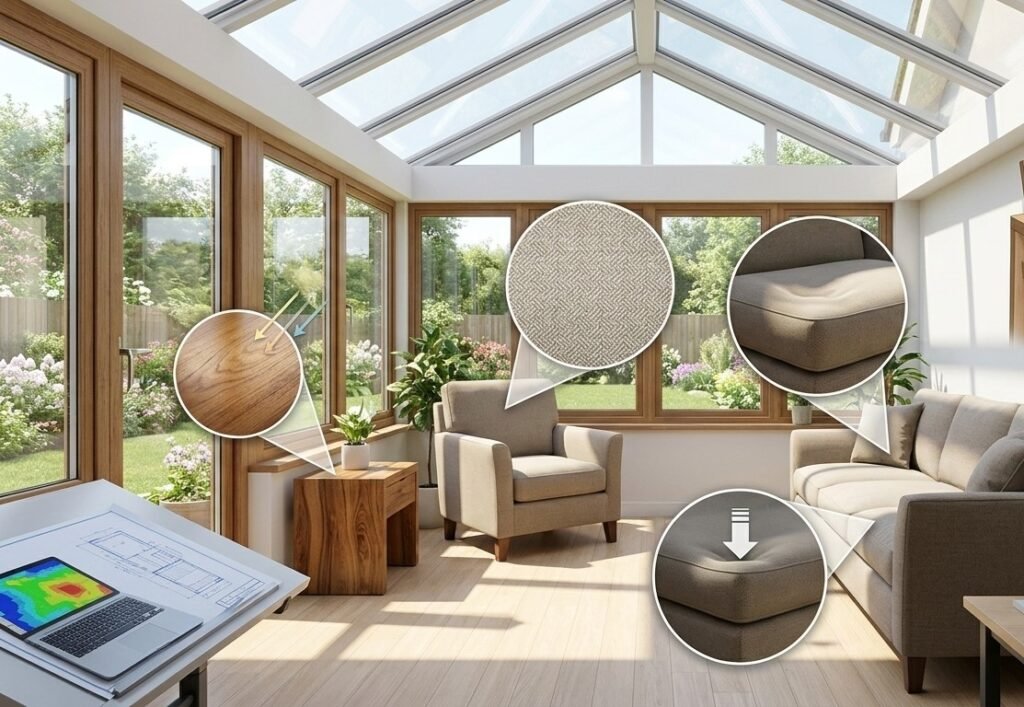
    High UV exposure degrades:

    • Fabric fibers
    • Cushion foam
    • Wood finishes
    • Adhesives

    UV passes through most untreated glass.

    Even Low-E glazing does not eliminate all UV radiation.

    Cushions may fade within 2–5 years without protective fabric.

    Resin wicker may become brittle in cold climates below freezing.

    Teak tolerates humidity but may silver over time.

    Indoor-only furniture in a 4-season sunroom may deteriorate rapidly.

    Material science matters.

    Flooring Thermal Behavior

    Flooring expands and contracts.

    Tile tolerates sunlight well.

    Engineered hardwood performs better than solid hardwood.

    Luxury vinyl plank must be rated for UV exposure.

    Concrete performs best structurally but may feel cold in winter.

    Floor insulation underneath is often underestimated. Cold floors reduce comfort significantly even when air temperature is stable.

    Condensation Case Analysis

    Condensation forms when glass surface temperature drops below dew point.

    In winter:

    Warm air inside meets cold glass.

    Without:
    • Low U-factor glazing
    • Adequate ventilation
    • Humidity control

    Condensation becomes frequent.

    Over time, this damages:
    • Window seals
    • Adjacent framing
    • Flooring
    • Furniture bases

    Condensation is not cosmetic. It is structural risk.

    20-Year Lifecycle Modeling

    Year 0–5:
    Minimal issues if properly specified.

    Year 5–10:
    Seal degradation may begin.

    Year 10–15:
    Cushion replacement likely.
    Minor hardware replacements.

    Year 15–20:
    Glass seal failure possible.
    Insulated unit replacement required.

    Sunrooms require long-term maintenance planning.

    Lifecycle thinking separates durable builds from short-term ones.

    Real-World Scenario: Under-Specified Sunroom

    Location: Midwest US
    Type: 4-season sunroom
    Glass: Basic double-pane
    Orientation: West-facing

    Result:
    Overheating in summer.
    HVAC strain.
    Condensation in winter.

    Root cause:
    SHGC too high.
    Ventilation inadequate. Lesson:
    Glass must match orientation.

    Real-World Scenario: Over-Specified Sunroom

    Location: Northern UK
    Type: 3-season room
    Glass: Triple-pane ultra-low SHGC
    Orientation: South-facing

    Result:
    Winter feels colder than expected.
    Solar gain blocked excessively.

    Lesson:
    Overengineering can reduce passive heating benefits. Balance beats extremes.

    Energy Cost Modeling Over 15 Years

    Assume:

    Basic glazing energy increase: $600/year
    High-performance glazing increase: $300/year

    15-year savings difference:
    $4,500

    Subtract $2,500 glazing upgrade:

    Net savings: $2,000

    Comfort benefit not included.

    Performance alignment compounds financially.

    Building Code & Resale Impact

    Poorly permitted sunrooms:

    • May not count as official square footage
    • May reduce resale value
    • May complicate insurance

    4-season sunrooms meeting energy code often increase perceived value significantly.

    Compliance matters.

    Most Expensive Sunroom Mistakes

    1. Ignoring climate
    2. Ignoring orientation
    3. Using indoor furniture in high UV
    4. Skipping insulation under flooring
    5. Failing to calculate HVAC load
    6. Choosing cheapest glazing

    Every mistake connects to underestimating environmental exposure.

    Sunroom Design Is System Design

    Sunroom success depends on:

    • Climate-aware glazing
    • Structural reinforcement
    • Ventilation engineering
    • Moisture control
    • Material durability
    • Lifecycle planning

    It is a system of interdependent parts.

    Remove one element and performance drops.

    Final System-Level Summary

    A sunroom is:

    • A high-glass environmental extension
    • A solar energy amplifier
    • A condensation risk zone
    • A UV exposure chamber
    • A thermal fluctuation space

    Comfort comes from alignment. Misalignment causes dissatisfaction. If you want more information on preventing condensation in sunroom windows, go check out our complete analysis on it.
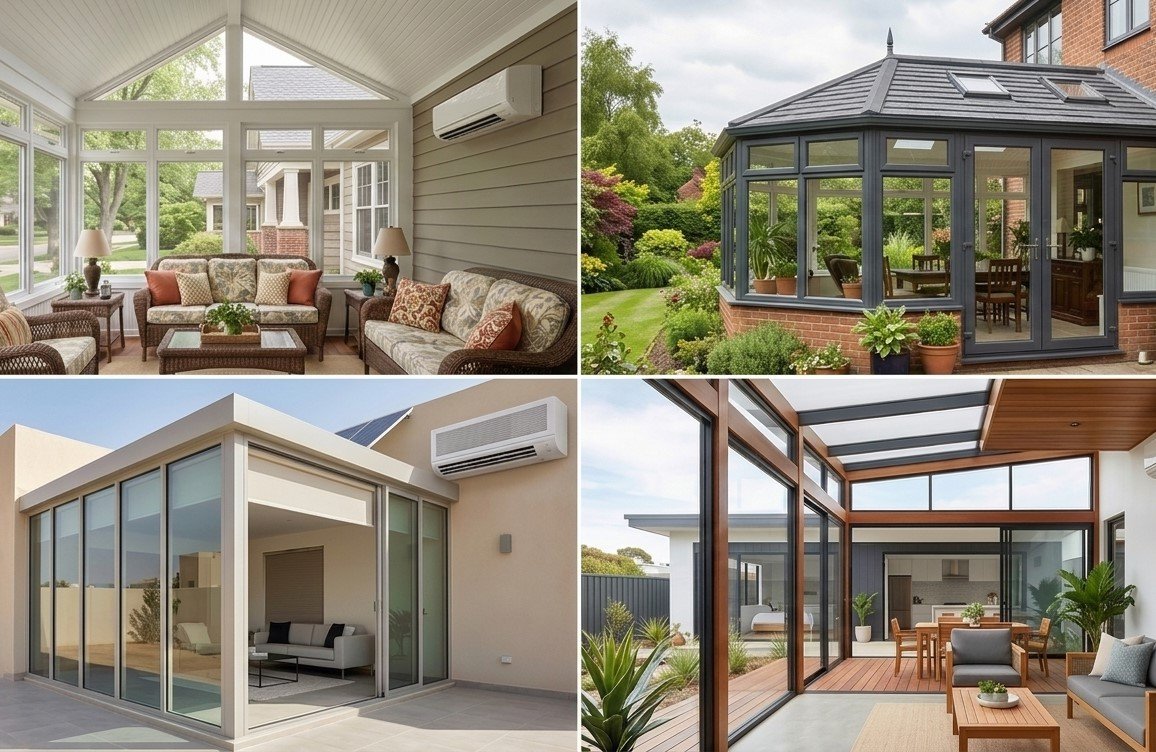

    Regional Sunroom Design Examples (US, UK, Middle East, Australia)

    How Sunroom Design Changes by Region

    Sunroom design is not universal. Regional climate patterns, building codes, cultural usage habits, and energy costs influence specifications.

    Below are four regional breakdowns.

    🇺🇸 United States — Mixed & Climate-Diverse Modeling

    The US contains multiple climate zones, so sunroom design varies significantly.

    Northern States (Minnesota, New York, Michigan)

    Primary concern: Winter heat retention

    Design traits:
    • Double or triple-pane Low-E glass
    • Vinyl or fiberglass frames
    • Insulated solid roof systems
    • HVAC extension or mini-split

    South-facing designs can reduce heating costs in winter through passive solar gain.

    West-facing sunrooms often require shading due to summer overheating.

    Energy costs vary widely by state, making glazing selection financially important.

    Southern States (Texas, Florida, Arizona)

    Primary concern: Solar heat gain

    Design traits:
    • Low SHGC glass
    • Solar control coatings
    • Exterior shading structures
    • Strong ventilation planning
    • Mold-resistant furnishings

    In Florida, humidity is as important as heat.
    In Arizona, SHGC matters more than U-factor.

    🇬🇧 United Kingdom — Conservatory Culture & Condensation Risk

    The UK has a long conservatory tradition.

    Primary challenges:
    • Damp winters
    • Moderate summers
    • High humidity
    • Frequent condensation
    Design traits:
    • Balanced SHGC glazing
    • Strong condensation management
    • Warm-edge spacers
    • Insulated roof retrofits (common upgrade trend)
    Many older UK conservatories suffer from:
    • Overheating in summer
    • Freezing conditions in winter

    Modern retrofits often replace polycarbonate roofs with insulated panels.

    Energy efficiency regulations are stricter now than in early 2000s builds.

    🇦🇪 Middle East — Extreme Solar Exposure

    In desert climates (UAE, Saudi Arabia):

    Primary challenge:
    Extreme solar radiation and high ambient temperatures.

    Design traits:
    • Very low SHGC (≤0.25)
    • Reflective or tinted glass
    • Exterior shading mandatory
    • Minimal west-facing glazing
    • Mechanical cooling required

    Glass roofing is rarely practical unless heavily shaded.

    Interior finishes must resist UV degradation.

    Over-insulating without controlling solar gain creates thermal traps.

    🇦🇺 Australia — UV Intensity & Bushfire Considerations

    Australia presents two main issues:

    1. High UV intensity
    2. Bushfire compliance in certain regions

    Design traits:

    • UV-stabilized glazing
    • Laminated safety glass in bushfire zones
    • Strong ventilation planning
    • Durable flooring materials

    North-facing sunrooms (in Southern Hemisphere) receive maximum winter sunlight.

    Orientation logic flips compared to Northern Hemisphere.

    This affects SHGC strategy.

    Regional Comparison Snapshot

    RegionPrimary RiskGlass PriorityStructural Focus
    Northern USHeat lossLow U-factorInsulation
    Southern USOverheatingLow SHGCVentilation
    UKCondensationBalancedMoisture control
    Middle EastExtreme solarUltra-low SHGCShading
    AustraliaUV & fireUV-stable glassSafety compliance

    Why Regional Modeling Matters

    Many guides ignore geography.

    But a sunroom that performs well in Minnesota will fail in Dubai.

    Regional design awareness:

    • Prevents overheating
    • Reduces condensation
    • Improves energy efficiency
    • Extends material lifespan

    This is where authority content separates from generic content.


    Climate Simulation Breakdowns: What Actually Happens in a Sunroom
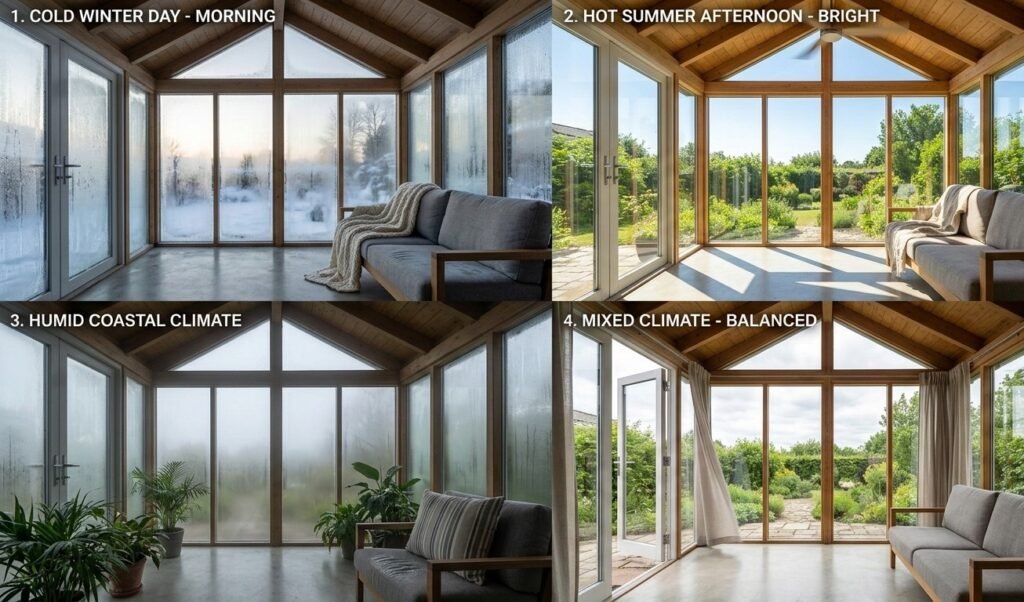
    Most guides say “sunrooms get hot” or “sunrooms lose heat.” That’s true, but vague. A better approach is to simulate how a sunroom behaves across a typical day and season, because comfort problems almost always show up in predictable patterns.

    These simulations are not lab-perfect models. They’re design-grade mental models that explain where failures happen and what specs prevent them.

    Simulation 1: Cold Winter Day (4-season sunroom, outside -5°C / 23°F)

    Morning (7–10 AM)

    • Outdoor air is cold.
    • Glass surfaces are coldest because they’ve been losing heat overnight.
    • Interior humidity meets cold glass and condensation forms if glazing is weak.

    Failure signal: water droplets at glass edges and along frames.

    Design fix logic:
    • Lower U-factor reduces glass surface cooling.
    • Warm-edge spacers prevent edge condensation.
    • Better seals reduce cold drafts that trigger dew point drop.

    Midday (11 AM–2 PM)

    • Sun begins heating interior through solar radiation.
    • South-facing sunrooms can gain noticeable warmth even in cold air.

    Success signal: interior temperature rises naturally without heavy HVAC cycling.

    Design fix logic:
    • Moderate SHGC is beneficial in cold climates.
    • Overly low SHGC can block useful winter solar gain, making the room feel dead and cold.

    Evening (5–10 PM)

    • Solar gain disappears.
    • Glass begins shedding heat rapidly.

    Failure signal: temperature drops faster than the rest of the home.

    Design fix logic:
    • Insulated roof and floor reduce rapid heat loss.
    • HVAC integration matters more than window type at this stage.

    Simulation 2: Hot Summer Afternoon (outside 40°C / 104°F, strong sun)

    Morning (8–11 AM)

    • Sun starts loading the glass.
    • Interior warms quickly due to radiant gain.

    Hidden insight: interior blinds reduce glare but don’t stop heat gain effectively because heat already passed through the glazing.

    Design fix logic:
    • Low SHGC solar control glass reduces heat entering in the first place.
    • Exterior shading is more effective than interior shading.

    Midday (12–4 PM)

    • Peak solar load.
    • West-facing rooms experience the worst spike in late afternoon.

    Failure signal: interior feels like a greenhouse and AC can’t keep up.

    Design fix logic:
    • Low SHGC is the main control variable.
    • Cross ventilation and stack ventilation reduce trapped heat.
    • Solid insulated roof performs better than glass roof here.

    Evening (6–10 PM)

    • Exterior temperature drops slowly in hot regions.
    • Stored heat in surfaces releases back into the room.

    Failure signal: room stays hot long after sunset.

    Design fix logic:
    • Thermal mass management (tile, concrete) can help if paired with night ventilation.
    • Poor ventilation traps heat overnight.

    Simulation 3: Humid Coastal Climate (high humidity, mild temperature swings)

    Primary issue is not temperature. It’s moisture behavior.

    Morning

    • Cool glass meets humid air.
    • Condensation can form even when it’s not “cold.”

    Failure signal: damp cushions, foggy windows, musty smell.

    Design fix logic:
    • Ventilation becomes non-negotiable.
    • Mold-resistant materials matter more than high insulation.
    • Moisture-tolerant flooring prevents hidden damage.

    Midday

    • Sun dries surfaces but humidity stays high.

    Hidden risk: furniture and cushions trap moisture internally.

    Design fix logic:
    • Quick-dry foam and breathable fabrics.
    • Air circulation prevents moisture stagnation.

    Simulation 4: Mixed Climate (cold winters, hot summers)

    Mixed climates punish “one-trick” designs.

    Winter need: low U-factor
    Summer need: low SHGC

    This creates a real design tension.

    Balanced approach:

    • Double-pane Low-E
    • Moderate SHGC (not extreme)
    • Shading options that can be adjusted seasonally
    • Operable windows for spring/fall

    Failure signal: room is uncomfortable in both seasons because specs are wrong for the region’s extremes.

    24-Hour Heat Cycle Snapshot (Simple Model)

    A sunroom generally follows this pattern:

    1. Overnight heat loss through glass
    2. Morning surface warming
    3. Midday solar heat gain peak
    4. Late afternoon overheating risk (west exposure)
    5. Evening rapid cool-down (cold climates) or slow cool-down (hot climates)

    If you design for these five phases, you design a comfortable sunroom.

    Practical “Simulation Outcomes” Checklist

    If your sunroom does any of these, it indicates a spec mismatch:

    • Condensation appears daily in winter
    • AC runs constantly in summer afternoons
    • Room becomes unusable during peak sun hours
    • Furniture fades unusually fast
    • Musty smell develops after humid weather

    Each symptom points directly to a design variable you can fix.

    Detailed Material Comparison: Sunroom System Components

    A sunroom is only as strong as its weakest material choice.

    The tables below compare performance trade-offs across glazing, frames, roofing, flooring, and furniture materials.

    Glass Package Comparison

    Performance-Oriented Glazing Matrix

    Glass TypeU-Factor (Typical)SHGC (Typical)Best ClimateOverheating RiskWinter Heat LossCost Tier
    Single Pane0.9–1.20.70–0.85Mild onlyVery HighVery HighLow
    Double Pane (clear)0.45–0.600.60–0.70ModerateHighModerateModerate
    Double Pane Low-E0.28–0.350.30–0.45MixedModerateLowModerate–High
    Triple Pane Low-E0.18–0.280.25–0.40ColdLowVery LowHigh
    Solar Control Glass0.30–0.400.20–0.30HotVery LowModerateHigh

    Interpretation

    • Cold climates prioritize U-factor.
    • Hot climates prioritize SHGC.
    • Mixed climates need balance.
    • Over-specifying SHGC can reduce winter comfort.

    There are vaste metrics regarding the types of Sunroom Windows that depend on the location, size, budgeting, ones’s own flavor of choice and elegancy, all explained with real world scenarios in our Sunroom Windows Deep Breakdown.

    Frame Material Comparison

    Frame TypeThermal ConductivityCondensation RiskExpansion StabilityMaintenanceBest Climate
    VinylLowLowModerateLowCold / Mixed
    Aluminum (no break)HighHighHighLowWarm
    Aluminum (thermal break)ModerateModerateHighLowMixed / Hot
    FiberglassLowLowVery StableLowAll climates
    WoodLowModerate (humidity)ModerateHighMild / Aesthetic focus

    Hidden Insight

    Aluminum without thermal break is a condensation magnet in cold climates.

    Fiberglass is structurally superior but more expensive.

    Roof System Comparison

    Roof TypeInsulation ValueSolar GainNoise ReductionClimate FitCost
    Solid Insulated PanelsHighLowHighCold / MixedModerate
    Full Glass RoofLow–ModerateVery HighModerateMildHigh
    Polycarbonate PanelsModerateHighLowModerateLower
    Hybrid Roof (glass + solid)BalancedBalancedBalancedMixedHigh

    Interpretation

    Glass roofing increases daylight but magnifies overheating risk.

    Solid insulated roofing improves temperature stability significantly.

    Hybrid roofs offer seasonal flexibility.

    Flooring Material Comparison

    Flooring TypeUV ResistanceExpansion ToleranceMoisture ResistanceComfortBest Climate
    Porcelain TileExcellentExcellentExcellentCool underfootHot
    Luxury Vinyl Plank (UV-rated)GoodGoodGoodModerateMixed
    Engineered HardwoodModerateModerateModerateWarmCold
    Solid HardwoodLowLowLowWarmMild
    Sealed ConcreteExcellentExcellentExcellentCoolAll climates

    Interpretation

    Solid hardwood performs poorly under high UV and temperature swings.

    Engineered hardwood is safer but still climate-dependent.

    Furniture Material Comparison

    Frame Materials

    MaterialUV ResistanceHumidity ToleranceCold ToleranceLifespan (Avg)Climate Fit
    Natural WickerLowModeratePoor (cracks)5–8 yrsMild
    Resin WickerHighHighModerate8–12 yrsMixed
    TeakHighHighGood15+ yrsAll
    Powder-Coated AluminumHighHighExcellent15+ yrsAll
    Upholstered WoodLowLowModerate5–10 yrsControlled

    Cushion & Fabric

    Fabric TypeFade ResistanceMold ResistanceMaintenanceLifespan
    Standard Cotton BlendLowLowModerate2–4 yrs
    Polyester Outdoor BlendModerateModerateLow4–6 yrs
    Performance Fabric (Sunbrella-type)HighHighLow6–10 yrs
    Quick-Dry FoamN/AHighLowLong

    Interpretation

    Indoor furniture rarely survives long-term in high-light sunrooms.

    Performance fabrics justify higher cost in 4-season rooms.

    HVAC Strategy Comparison

    SystemInstallation ComplexityEnergy EfficiencyCostBest For
    Extend Central HVACModerateModerateMedium4-season
    Mini-Split SystemModerateHighMedium–HighAll climates
    Electric BaseboardLowLowLowMild climates
    Radiant FloorHighHighHighCold climates

    Mini-splits often provide the most controlled performance.

    Material Decision Logic Summary

    If climate is cold:

    • Prioritize insulation
    • Vinyl or fiberglass frames
    • Double or triple pane
    • Insulated roof

    If climate is hot:

    • Prioritize low SHGC
    • Solar control glass
    • Exterior shading
    • Ventilation-first approach

    If climate is humid:

    • Mold-resistant materials
    • Corrosion-resistant frames
    • Ventilation planning

    This is system thinking, not component thinking.

    Real Project Example: Cold vs Hot Climate Contrast

    Case A — Minneapolis, US (Cold Climate)

    Client built a 240 sq ft south-facing 4-season sunroom.

    Initial quote included standard double-pane glass (U-factor 0.50).
    After modeling, they upgraded to Low-E double-pane (U-factor 0.28).

    Results over first 2 winters:

    • Interior temperature more stable
    • Condensation nearly eliminated
    • Heating bill impact lower than expected

    Upgrade cost difference: ~$2,700
    Estimated 15-year energy impact: positive ROI

    Comfort outcome: year-round usable reading space.

    Case B — Dubai, UAE (Extreme Solar)

    Client built 200 sq ft glass-heavy sunroom with standard glazing.

    Problem:
    Afternoon temperature exceeded comfort range even with AC.

    Solution retrofit:

    • Added solar control film
    • Installed exterior shading
    • Improved ventilation

    Lesson:
    SHGC miscalculation created a thermal trap.

    Cost of correction exceeded initial glazing upgrade cost.

    The difference between these two projects was not budget.
    It was climate alignment.

    Advanced ROI Modeling: 15-Year Energy & Lifecycle Impact

    Sunrooms influence energy use more than most homeowners expect. The financial outcome depends on:

    • Climate zone
    • Glazing specification
    • Orientation
    • Energy rates
    • HVAC integration

    Below are modeled examples using realistic global energy rate averages.

    These are structured projections, not guaranteed savings.

    Assumed Energy Rate Baseline (Global Averages)

    RegionElectricity (per kWh)Natural Gas (per therm equivalent)
    United States$0.16$1.20
    United Kingdom£0.28£1.10
    AustraliaAUD $0.30N/A (electric-heavy)
    UAE$0.08Minimal heating need

    Energy rates strongly influence ROI speed. If you want to go one-step further, go into the specifics of energy performance of sunroom glazing systems.
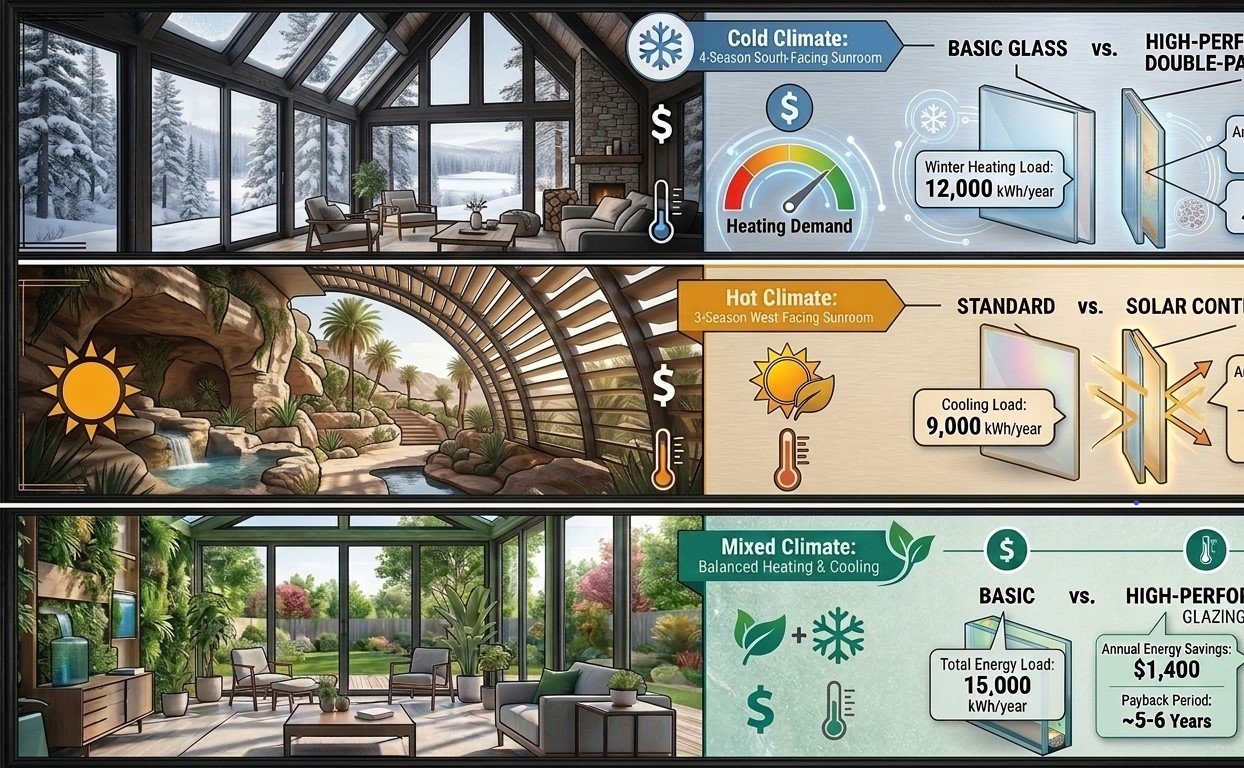

    Scenario 1: Cold Climate ROI Model (Northern US / Canada Equivalent)

    Sunroom size: 220 sq ft
    Type: 4-season
    Orientation: South-facing

    Option A — Basic Double Pane (U-factor 0.50)

    Estimated additional winter heating load:
    ~3,000–3,500 kWh per year equivalent

    Annual heating cost impact:
    ~$480–$560

    Option B — High-Performance Double Pane (U-factor 0.28)

    Estimated heating load:
    ~1,800–2,200 kWh per year

    Annual heating cost impact:
    ~$290–$350

    Annual Savings Difference

    ~$200–$250 per year

    Upgrade cost difference:
    $2,500–$3,000

    Simple payback:
    10–12 years

    15-Year Projection

    Savings:
    $3,000–$3,750

    Net gain after upgrade:
    ~$750–$1,200

    Comfort benefits excluded.

    Scenario 2: Hot Climate ROI Model (Arizona / Middle East Equivalent)

    Sunroom size: 220 sq ft
    Type: 3-season
    Orientation: West-facing

    Option A — Standard Double Pane (SHGC 0.65)

    Estimated additional cooling load:
    ~2,800–3,200 kWh annually

    Cooling cost impact (US rate):
    ~$450–$510 annually

    Option B — Solar Control Glass (SHGC 0.25)

    Cooling load:
    ~1,600–1,900 kWh

    Cooling cost:
    ~$250–$300 annually

    Annual Savings Difference

    ~$200–$220 per year

    Upgrade cost:
    ~$2,000 Payback:
    ~9–10 years

    Middle East Variation

    Electricity cost lower ($0.08/kWh).

    Annual savings difference:
    ~$100–$120 per year

    Payback period longer:
    ~15–18 years But overheating mitigation remains comfort-critical.

    Scenario 3: Mixed Climate ROI (UK / Midwest US Equivalent)

    Heating + Cooling balanced.

    Basic glazing annual extra load:
    ~2,500 kWh equivalent

    High-performance glazing:
    ~1,600 kWh

    Savings:
    ~900 kWh annually

    At UK rate (£0.28/kWh):
    £252 annually

    Upgrade cost:
    £2,000–£3,000

    Payback:
    8–12 years

    Higher electricity rates accelerate ROI.

    Passive Solar Gain Value Modeling (Cold Climate Bonus)

    South-facing 4-season sunroom can reduce heating load on adjacent rooms.

    Estimated offset:
    ~500–800 kWh per year

    At $0.16/kWh:
    $80–$130 annual benefit

    Over 15 years:
    $1,200–$1,950 additional value

    Proper orientation increases ROI significantly.

    Lifecycle Cost Modeling (20-Year View)

    ComponentTypical Replacement CycleEstimated Cost
    Insulated Glass Units15–20 years$2,000–$4,000
    Cushion Replacement5–8 years$800–$1,500
    Seal Repairs10–15 years$500–$1,000

    Upfront investment in higher-quality materials often reduces long-term replacement frequency.

    Cheap builds cost more over 20 years.

    Comfort ROI (Non-Monetary but Influential)

    Financial models ignore:

    • Increased usable space
    • Reduced HVAC strain
    • Enhanced property appeal
    • Lifestyle value

    In resale markets, a properly permitted 4-season sunroom can increase perceived square footage value significantly.

    In many US regions, finished space valuation ranges between $50–$150 per sq ft depending on build quality.

    Net Present Value Perspective (Simplified)

    If annual energy savings average $250
    Over 15 years at modest inflation

    Total savings: ~$4,000

    Discounted value depends on rate assumptions, but real-world ROI is positive when:

    • Energy rates are high
    • Climate is extreme
    • Glazing is optimized

    ROI accelerates in high-electricity-cost regions.

    Financial Modeling Summary

    ClimateEnergy Savings ImpactROI SpeedComfort Benefit
    ColdModerate–High10–12 yrsHigh
    HotModerate9–15 yrsVery High
    HumidModerateSlowerCritical
    MixedBalanced8–12 yrsHigh

    Sunrooms are rarely short-term investments. They are long-horizon environmental assets.

    When a Sunroom Is Not the Right Solution

    Sunrooms are powerful spaces, but not ideal in every scenario.

    It may be the wrong choice if:

    • The region has extreme heat and no shading option
    • Budget does not allow climate-appropriate glazing
    • The space will be used as a fully insulated bedroom without HVAC integration
    • Structural modifications exceed cost of full home extension
    • Orientation forces severe west-facing solar exposure with no mitigation

    In these cases, alternatives such as insulated room additions or shaded patio enclosures may perform better long term.

    Good design includes knowing when not to build.


    Final Authority Statement
    A sunroom’s financial performance depends on:

    • Climate alignment
    • Orientation awareness
    • Glass specification
    • Insulation integrity
    • Energy cost context

    When properly engineered, a sunroom can:

    • Reduce seasonal energy waste
    • Improve daily comfort
    • Increase long-term property appeal
    • Deliver measurable operating savings

    When poorly specified, it becomes a recurring expense.

    System thinking determines outcome.

    FAQ Section

    What is the difference between a sunroom and a conservatory?

    A conservatory is typically more ornate and glass-dominant, often with glass roofing. A sunroom may have mixed roofing and modern insulation.

    Can a sunroom be used year-round?

    Yes, if built as a 4-season insulated structure with HVAC integration.

    Do sunrooms increase home value?

    High-quality 4-season sunrooms often increase buyer appeal and usable square footage perception.

    Does a sunroom need insulation?

    Yes. Without insulation, temperature swings are extreme.

    What is the biggest mistake in sunroom design?

    Choosing glass based on price instead of climate and orientation.

  • Sunroom Windows: Types, Glass Options, Energy Efficiency & Climate Performance

    Sunroom windows are specialized glazing systems designed to maximize daylight while managing insulation, ventilation, and seasonal temperature swings. The right system depends on whether the room is 3-season or 4-season, your climate zone, frame material durability, and glass performance ratings like U-factor and SHGC.

    What are sunroom windows and how are they different from regular house windows?

    Short answer: Sunroom windows are designed for higher glass exposure and seasonal climate variability compared to standard house windows.

    Unlike typical residential windows installed in insulated wall cavities, sunroom windows often occupy larger surface areas and face direct solar exposure for extended hours. This changes thermal load dynamics.

    Key differences:
    • Greater glass-to-wall ratio
    • Higher solar heat gain exposure
    • Increased condensation risk
    • Often part of modular enclosure systems

    Using standard house windows in a sunroom can lead to overheating in summer or heat loss in winter if performance specs are not matched to exposure.

    Most people assume sunroom windows are just “more windows.” That assumption causes performance problems.

    A traditional home window is surrounded by insulated framing and integrated into a wall system designed for thermal buffering. A sunroom window often makes up 50–80% of the wall area. That changes:

    • Heat load dynamics
    • Air pressure behavior
    • Condensation risk
    • Structural stress from wind

    Because glass becomes the dominant surface, its thermal characteristics matter exponentially more than in a conventional room.

    In colder climates, improper glazing turns the sunroom into a cold sink. In warmer climates, it becomes a greenhouse. That is why sunroom windows must be specified differently than bedroom or kitchen windows.


    What types of sunroom windows are available?

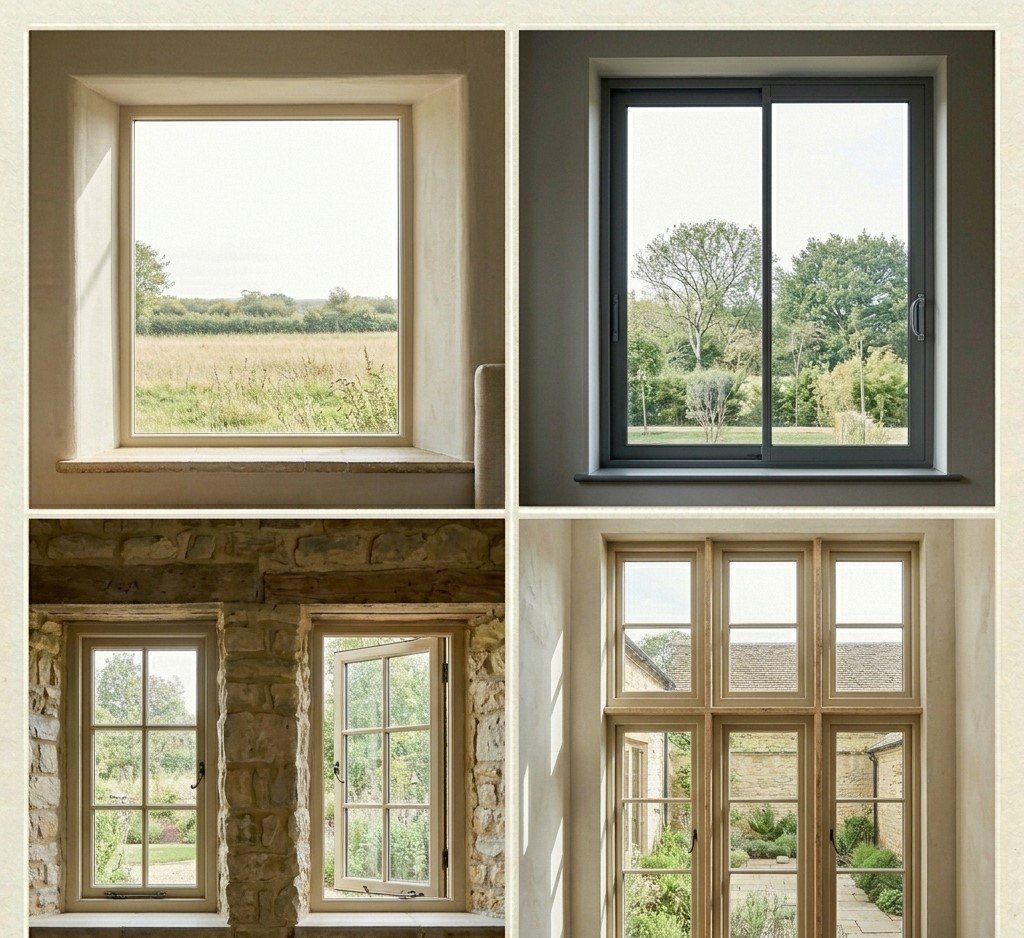
    Sunroom Windows

    Short answer: Fixed, sliding, casement, double-hung, and floor-to-ceiling panels are most common.

    Fixed Windows

    Do not open. Maximize light and insulation. Best for controlled climates.

    Sliding Windows

    Horizontal operation. Good ventilation with moderate energy efficiency.

    Casement Windows

    Hinged, crank-operated. Provide excellent airflow and tight seals.

    Double-Hung Windows

    Vertical sliding sashes. Balanced ventilation option.

    Floor-to-Ceiling Panels

    Used in panoramic sunrooms. Highest daylight gain but require high-performance glass.

    Beyond basic style categories, selection should be based on air exchange goals and structural configuration.

    Ventilation Strategy Modeling

    • Fixed + Casement combination improves airflow control.
    • Sliding windows work well for screened sunrooms but leak more air in winter.
    • Stacked operable windows allow seasonal adaptation.

    In humid climates, ventilation capacity reduces mold risk. In dry climates, excessive ventilation increases dust infiltration.

    The “type” is not aesthetic. It is environmental strategy.

    Ventilation Comparison Table

    TypeVentilationSeal StrengthEnergy EfficiencyBest Use
    FixedNoneExcellentHigh4-season rooms
    SlidingModerateGoodMedium3-season
    CasementHighExcellentHighClimate-variable
    Double-hungModerateGoodMediumMild climates

    What are sunroom windows in simple terms?

    Sunroom Windows

    Sunroom windows are high-exposure glazing systems designed to maximize natural light while controlling heat gain, heat loss, condensation, and ventilation. Their performance depends on climate, orientation, glass specifications like U-factor and SHGC, and whether the room is 3-season or 4-season. Wanting more information on “What is a Sunroom overall in simple terms?“, head on out to our complete sunroom design guide breaking down on its different aspects, features and metrics.

    Sunroom Windows in 8 Practical Rules

    • Match U-factor to winter temperatures
    • Match SHGC to summer sun exposure
    • Design ventilation intentionally
    • Consider orientation before choosing glass
    • Use insulated glazing for 4-season rooms
    • Choose corrosion-resistant frames in humid areas
    • Plan for seal lifespan of 15–20 years
    • Verify local building code compliance

    If You Live in…

    • A cold climate → prioritize low U-factor and insulated frames
    • A hot climate → prioritize low SHGC and shading
    • A humid climate → prioritize ventilation and condensation control
    • A mixed climate → choose balanced SHGC and double-pane Low-E

    Sunroom Windows

    What is the difference between 3-season and 4-season sunroom windows?

    Short answer: 3-season windows focus on airflow and light. 4-season windows prioritize insulation and thermal control.

    3-Season Sunroom Windows

    • Usually single or double pane
    • Minimal insulation
    • Not designed for freezing climates

    Ideal for spring through fall

    4-Season Sunroom Windows

    • Double or triple pane
    • Low-E coatings
    • Insulated frames
    • Compatible with HVAC systems

    4-season windows require lower U-factor ratings and controlled SHGC to prevent energy loss.

    The difference is insulation performance under thermal gradient stress.

    In a 3-season room, glass only needs to block wind and moderate rain. Insulation is secondary.

    In a 4-season room, glass must manage:

    • Interior heat retention in winter
    • Solar heat control in summer
    • Condensation resistance
    • HVAC compatibility

    A double-pane window with a U-factor of 0.30 performs dramatically better in winter than a single-pane unit with a U-factor above 1.0.

    Failure to account for this difference leads to heating bills that rival full home additions.

    3-Season vs 4-Season Sunroom Windows (Quick Comparison)

    Feature3-Season4-Season
    InsulationMinimalHigh
    Glass TypeSingle or Basic DoubleDouble or Triple Pane
    HVAC CompatibleNoYes
    Winter UseLimitedFull
    CostLowerHigher

    Understanding Window Ratings (In 30 Seconds)

    • U-factor measures heat loss. Lower is better in cold climates.
    • SHGC measures solar heat gain. Lower is better in hot climates.
    • STC measures sound reduction. Higher reduces outside noise.

    The Most Common Sunroom Window Mistake

    Choosing glass based on price instead of climate and orientation.
    This often causes:
    • Overheating in summer
    • Condensation in winter
    • Higher energy bills

    Sunroom Windows Are Not Ideal When:

    • The structure cannot support insulated glass weight
    • No ventilation is possible
    • West-facing exposure lacks shading in hot climates
    • Budget does not allow insulated glazing for 4-season use

    Which frame materials are best for sunroom windows?

    Sunroom Windows

    Short answer: Vinyl and aluminum dominate, but climate dictates the best option.

    Vinyl

    • Low maintenance
    • Strong insulation
    • Affordable
    • Ideal for cold climates

    Aluminum

    • Lightweight
    • Slim profile
    • Conducts heat more easily
    • Better in warm climates

    Fiberglass

    • High durability
    • Stable in extreme climates
    • Higher cost

    Wood

    • Strong insulation
    • High maintenance outdoors

    Frame selection affects condensation resistance and lifespan more than aesthetics alone.

    Frames create thermal bridges.

    Aluminum frames transfer heat quickly. In hot climates, that may not matter. In cold climates, it causes interior condensation.

    Vinyl frames insulate better but may expand and contract more in extreme heat.

    Fiberglass frames offer high dimensional stability and thermal performance but at higher cost.

    The choice is not about durability alone. It is about thermal conductivity vs environmental stress.


    What glass options work best for sunrooms?

    Sunroom Windows

    Short answer: Double-pane Low-E glass with argon gas is the standard for energy efficiency.

    Single Pane

    Low cost. Minimal insulation. Best only for mild climates.

    Double Pane (IGU)

    Two glass layers separated by spacer. Reduces heat transfer significantly.

    Triple Pane

    Highest insulation. Suitable for extreme cold climates.

    Low-E Coating

    Reflects infrared heat while allowing visible light.

    Argon Gas

    Improves insulation between panes.

    Glass technology is where sunroom performance is won or lost.

    Low-E Coating Types

    There are two main types:

    • Hard-coat Low-E (better for colder climates)
    • Soft-coat Low-E (better for solar control)

    Soft-coat Low-E provides lower SHGC, reducing overheating.

    Spacer Technology

    Warm-edge spacers reduce condensation along glass edges. Standard aluminum spacers increase edge heat loss.

    Gas Fills

    Argon is common. Krypton is higher performance but more expensive.

    These micro-decisions significantly affect comfort and condensation control.

    Glass Performance Table

    FeatureControls Heat LossControls Heat GainImproves Comfort
    Low-EYesYesYes
    Argon GasYesPartialYes
    Triple PaneYesYesYes
    Tinted GlassNoYesModerate

    Understanding U-factor (heat loss rate) and SHGC (solar heat gain) is essential for climate matching.

    Are sunroom windows energy efficient?

    Short answer: Yes, when properly specified for climate and seasonal use.

    Energy efficiency depends on:
    • Glass layers
    • Frame insulation
    • Seal quality
    • Installation precision

    A 4-season sunroom with insulated glazing can reduce heating loss by up to 30–50% compared to single-pane systems.

    Energy efficiency depends on solar orientation.
    A north-facing sunroom may lose more heat than it gains in winter. A south-facing sunroom may gain excessive heat in summer.

    Optimizing SHGC:
    • Cold climates benefit from moderate SHGC to capture winter sun.
    • Hot climates require lower SHGC to prevent overheating.

    Energy efficiency is not one-size-fits-all. It is climate-matched engineering.


    How do sunroom windows affect temperature control and overheating?

    South-facing sunrooms can overheat rapidly.

    Factors influencing overheating:
    • High SHGC glass
    • Lack of cross ventilation
    • No shading solutions
    Solutions:
    • Low-E coatings
    • Solar control glass
    • Operable windows for airflow
    • Exterior shading systems

    Proper glazing selection prevents greenhouse effect buildup.

    Sunrooms amplify solar radiation.

    Direct sunlight through glass can increase interior temperature by 15–25°F above outdoor ambient levels if unmanaged.

    Learn more about Sunroom Heating and Cooling with all the different metrics, costing along with varied examples to help understand it to an expert level.

    Solutions include:
    • Exterior shading systems
    • Tinted or reflective glass
    • Ventilation planning
    • Ceiling fans for thermal circulation

    Passive control reduces reliance on mechanical cooling.

    Do sunroom windows provide ventilation and airflow?

    Yes, depending on window style.

    Casement windows allow up to 100% sash opening. Sliding windows allow 50% opening. Cross ventilation requires openings on opposing walls.

    Stack effect ventilation can also be used in taller sunrooms to exhaust hot air upward.

    Ventilation must be designed, not assumed.

    Cross ventilation requires:
    • Operable windows on opposing walls
    • Vertical variation in height to create stack effect
    • Adequate opening area ratio

    Minimum recommendation:
    Operable area equal to at least 10–15% of total floor area for effective airflow.

    Without airflow planning, moisture accumulates even in insulated systems.

    How much do sunroom windows cost?

    Cost varies by size, glass type, and frame material.

    Estimated ranges:
    • 3-season systems: $300–$700 per window
    • 4-season insulated windows: $600–$1,500 per unit
    • Full sunroom glazing systems: $8,000–$25,000+

    Installation complexity increases cost significantly.

    Beyond base price, cost includes:
    • Glass performance upgrades
    • Custom sizing
    • Structural reinforcement
    • Permits
    • Installation labor
    • Energy code compliance
    Hidden cost drivers:
    • Non-standard shapes
    • Large floor-to-ceiling panels
    • High wind rating requirements

    Always evaluate cost per square foot of glass, not per window alone.


    Do sunroom windows require permits or meet building codes?

    In many regions, yes.

    Code considerations:
    • Tempered safety glass requirements
    • Energy efficiency ratings
    • Structural wind load
    • Hurricane impact zones

    Permit requirements vary by country and local jurisdiction.

    Many regions classify 4-season sunrooms as habitable space.

    This may trigger:
    • Energy code compliance
    • Structural inspection
    • Egress requirements
    • Safety glazing mandates

    Tempered or laminated glass is often required below certain heights for impact safety.

    Ignoring compliance can complicate resale.

    How long do sunroom windows last?

    Lifespan varies by material and seal quality.

    • Vinyl frames: 20–30 years
    • Aluminum: 15–25 years
    • Glass seals: 15–20 years average

    Seal failure is the most common reason for replacement.

    The glass seal is the weak point.

    Double-pane units rely on perimeter seals to contain insulating gas. UV exposure and temperature cycling eventually degrade seals.

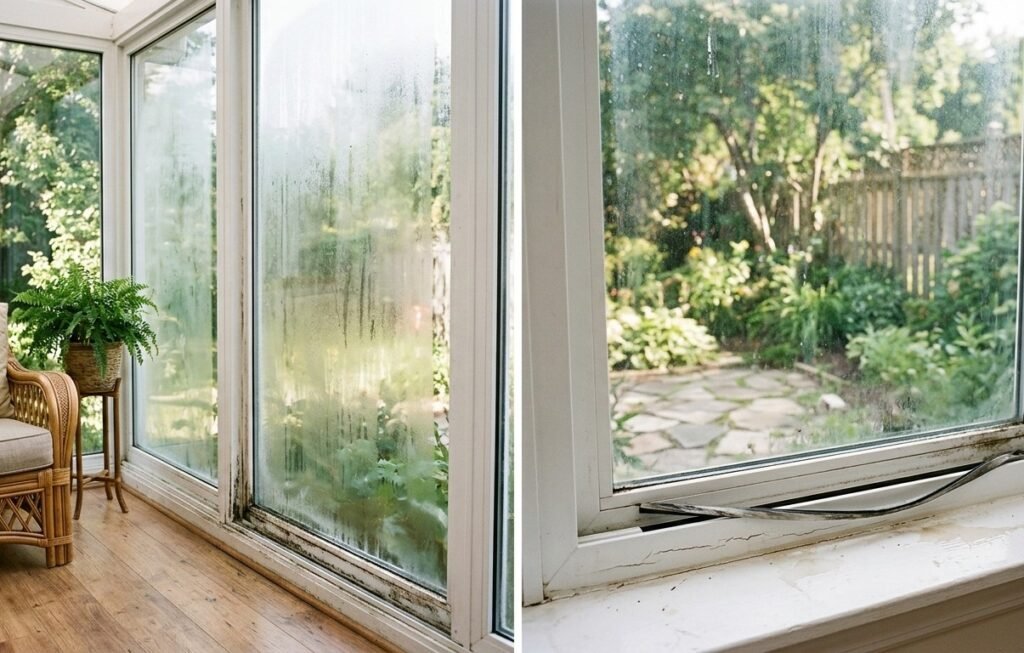
    Signs of failure:
    • Fogging between panes
    • Visible condensation inside glass layers
    • Reduced clarity

    Seal lifespan averages 15–20 years.

    Frame longevity may exceed glass longevity.

    Can you replace sunroom windows without rebuilding the structure?

    Often, yes.

    Retrofit replacement depends on:
    • Frame compatibility
    • Structural integrity
    • Glass sizing

    Energy upgrades can usually be performed without full rebuild.

    Replacement feasibility depends on frame integration.

    Modular sunroom systems often allow panel replacement without structural modification.

    Site-built sunrooms may require reframing.

    Upgrading from single-pane to double-pane often improves comfort dramatically without altering the entire room.


    What common problems occur with sunroom windows?

    Most common issues:
    • Condensation
    • Seal fogging
    • Drafts
    • Overheating
    • Glare

    These issues usually trace back to improper glass selection or installation shortcuts.

    Condensation

    Caused by interior humidity and cold glass surface temperature.

    Seal Fogging

    Caused by perimeter seal failure.

    Overheating

    Caused by high SHGC and poor ventilation.

    Glare

    Caused by high visible transmittance and direct sun angles.

    Each problem traces back to glass specification or airflow planning.

    Are sunroom windows worth the investment?

    For many homeowners, yes.

    Benefits:
    • Increased usable living space
    • Higher property appeal
    • Enhanced natural lighting
    • Potential resale value improvement

    Properly specified sunroom windows improve comfort and long-term usability.

    Financial ROI is one factor. Lifestyle ROI is larger.

    A 4-season sunroom expands usable square footage without full structural expansion.

    Energy-efficient glazing reduces comfort complaints.

    Property resale often benefits when sunrooms are classified as climate-controlled space.


    How do sunroom windows perform in different climate zones?

    Sunroom window performance is dictated by climate stress patterns, not marketing labels. The same glazing package behaves differently in Arizona, Toronto, Dubai, or London.

    Performance must be modeled across four environmental stress variables:
    1. Temperature extremes
    2. Solar radiation intensity
    3. Humidity levels
    4. Wind pressure and precipitation

    Ignoring any one of these produces comfort imbalance.

    Sunroom Window Climate Fit Matrix

    Climate TypeIdeal U-FactorIdeal SHGCFrame RecommendationVentilation PriorityCommon Risk
    Cold / Snow≤ 0.300.35–0.45Vinyl / FiberglassModerateCondensation
    Hot / Desert0.30–0.40≤ 0.30Aluminum / FiberglassHighOverheating
    Humid / Coastal≤ 0.350.30–0.40Vinyl / Corrosion-resistant AluminumHighMoisture buildup
    Mixed / Temperate0.30–0.350.35–0.45Vinyl / FiberglassModerateSeasonal imbalance

    Cold & Snow-Dominant Climates

    Primary challenge: heat retention and condensation prevention

    In regions where winter temperatures drop below freezing, glass surface temperature becomes critical. If interior glass temperature falls below dew point, condensation forms.

    Required specifications:

    • U-factor of 0.30 or lower
    • Double or triple pane
    • Argon or krypton gas
    • Warm-edge spacers
    • Thermally broken frames

    Hidden insight:

    Triple-pane glass reduces heat loss but also reduces solar gain. In extremely cold but sunny regions, moderate SHGC can help passive solar warming during winter.

    Design must balance insulation and sunlight harvesting.

    Hot & High-Solar Climates

    Primary challenge: solar heat gain control

    In desert or equatorial regions, overheating becomes the main risk. Glass can act like a magnifying lens.

    Required specifications:

    • Low SHGC (0.25–0.35 range)
    • Solar control Low-E coating
    • Exterior shading devices
    • Cross ventilation design

    Hidden insight:

    Interior blinds alone do not stop heat gain. Solar heat passes through glass before blinds block visible light. External shading is far more effective. Orientation awareness matters more than window size.

    Humid & Coastal Climates

    Primary challenge: moisture and corrosion

    High humidity increases condensation frequency. Coastal salt accelerates frame degradation.

    Required specifications:

    • Corrosion-resistant frames
    • Insulated glass to reduce surface cooling
    • Operable windows for airflow
    • Proper flashing and drainage

    Hidden insight:

    Condensation is not always a sign of failure. It may indicate indoor humidity imbalance. Ventilation design must be paired with glazing choice.


    Mixed & Temperate Climates

    Primary challenge: seasonal adaptability

    These regions experience both heating and cooling demands.

    Required specifications:

    • Balanced SHGC (around 0.35–0.45)
    • Double-pane Low-E
    • Operable ventilation

    Hidden insight:

    Balanced performance often outperforms extreme insulation in mixed climates. Overspecifying glass can reduce natural solar heating in winter.

    Performance should match annual average exposure patterns.

    How do sunroom windows impact condensation and moisture control?

    Condensation occurs when warm moist air contacts a cold surface.

    Glass temperature is the controlling variable.

    What influences surface temperature?

    • Outdoor temperature
    • U-factor
    • Frame conductivity
    • Air leakage

    Dew Point Dynamics

    If interior humidity is 50 percent and glass surface temperature drops below dew point, condensation forms.

    Lowering indoor humidity to 35–40 percent in winter reduces condensation risk significantly.

    Hidden engineering reality

    Edge-of-glass condensation is common due to spacer conductivity. Warm-edge spacers reduce this localized heat loss.

    Condensation management is as much about indoor humidity control as it is about window selection.


    What safety features should sunroom windows have?

    Safety glazing is often required by building codes when glass extends close to floor level.

    Tempered Glass

    Heat-treated for strength. Breaks into small blunt fragments.

    Laminated Glass

    Contains interlayer that holds fragments together upon impact.

    Impact-Rated Glass

    Designed for hurricane zones and high-wind areas.

    Structural Load Resistance

    Sunroom glazing must withstand:

    • Wind pressure
    • Snow load on integrated structures
    • Thermal expansion

    Hidden insight:

    Large glass panels increase structural stress. Frame reinforcement is often overlooked but critical.

    Security locking systems matter for ground-level sunrooms.

    How do sunroom windows influence noise reduction?

    Glass thickness and layering influence sound transmission.

    STC (Sound Transmission Class)

    Higher STC reduces noise infiltration.

    Double-pane windows improve noise reduction over single-pane. Laminated glass provides further acoustic dampening due to interlayer absorption.

    Urban settings benefit significantly from laminated insulated units.

    Hidden insight:

    Air gaps of varying thickness improve sound isolation. Identical glass thickness layers transmit similar frequencies more easily.

    Acoustic comfort adds value beyond thermal comfort.


    What maintenance do sunroom windows require?

    Maintenance prevents performance decline.

    Routine Care:

    • Clean tracks and seals
    • Inspect caulking annually
    • Check drainage holes
    • Inspect frame expansion gaps

    Seal Longevity:

    Gas-filled units degrade over time. UV exposure accelerates seal aging.

    Signs of performance decline:

    • Fogging between panes
    • Draft sensation
    • Visible warping

    Preventive inspection extends usable life.

    How do sunroom windows affect interior furnishings and UV exposure?

    Ultraviolet radiation degrades:

    • Fabrics
    • Wood finishes
    • Flooring
    • Artwork

    Low-E coatings block a large portion of UV rays. However, visible light still enters.

    Hidden insight:

    UV exposure damage is cumulative. Even moderate daily exposure over years leads to noticeable fading.

    Selecting UV-protective glazing protects interior investments.


    How does sunroom window orientation affect performance?

    Orientation is one of the most overlooked design variables.

    South-Facing

    High winter gain. High summer overheating risk.

    North-Facing

    Lower solar gain. Greater heat loss risk in winter.

    East/West

    Morning and afternoon glare challenges.

    Correct SHGC specification must align with orientation.

    Sunroom Orientation Decision Matrix

    OrientationWinter ImpactSummer ImpactGlass StrategyRisk Level
    South-FacingStrong passive gainHigh overheating riskModerate SHGC + shadingMedium
    North-FacingHeat loss dominantMinimal overheatingLow U-factor priorityHigh (cold climates)
    East-FacingMorning glareMild overheatingLow SHGC + blindsMedium
    West-FacingAfternoon heat spikeHigh glareLow SHGC + exterior shadingHigh (hot climates)

    Hidden Insight

    South-facing sunrooms in cold climates can reduce heating load.
    West-facing sunrooms in hot climates are the hardest to manage.

    Orientation is a larger performance variable than window size.

    Why Condensation Happens in Sunroom Windows (And How to Prevent It)

    Sunrooms have a higher glass-to-wall ratio than typical rooms. That means more surface area exposed to exterior temperature swings. If you want more information on how insulation and glazing work together in sunrooms, head onto our Sunroom Guide where it is discussed to full length.

    Why Do Sunroom Windows Condense More Than Regular Windows?

    Condensation forms when warm interior air contacts glass whose surface temperature falls below the dew point.

    In winter:

    • Exterior air is cold
    • Glass surface cools rapidly
    • Interior humidity touches cold glass
    • Moisture forms

    Sunrooms are more vulnerable because they cool faster overnight.

    What Increases Condensation Risk?

    • High U-factor glass
    • Aluminum frames without thermal breaks
    • High interior humidity
    • Poor air circulation
    • Edge-of-glass spacer conductivity

    Edge condensation often appears before center-glass condensation.

    That’s a spacer issue, not just glazing thickness.

    Frame-Driven Condensation Risk Table

    Frame TypeWinter Surface TemperatureCondensation Risk
    Aluminum (no break)Very ColdHigh
    Aluminum (thermal break)ModerateMedium
    VinylWarmerLow
    FiberglassWarmVery Low

    This is why aluminum frames fail in cold climates without thermal breaks.

    How to Prevent Condensation in Sunroom Windows

    1. Choose lower U-factor glass
    2. Use warm-edge spacers
    3. Avoid non-thermal-break aluminum in cold zones
    4. Improve ventilation
    5. Control indoor humidity

    Condensation is a design failure, not a random event.

    Sunroom Window Frame Material Comparison (Structural + Thermal)

    What Is the Best Frame Material for Sunroom Windows?

    Frame material affects:

    • Thermal bridging
    • Expansion stability
    • Seal longevity
    • Structural rigidity
    • Condensation risk

    It is not just aesthetic.

    Frame Material Comparison Table

    Frame TypeThermal PerformanceExpansion StabilityMaintenanceClimate FitLifespan
    VinylHighModerateLowCold / Mixed20+ yrs
    FiberglassVery HighVery StableLowAll climates25+ yrs
    Aluminum (no break)LowVery StableLowWarm only20+ yrs
    Aluminum (thermal break)ModerateVery StableLowMixed / Hot20+ yrs
    WoodHighModerateHighMild15–20 yrs

    Thermal Bridging Explained Simply

    Metal conducts heat faster than vinyl or fiberglass.

    In cold climates, aluminum frames without thermal breaks:
    • Lower interior surface temperature
    • Increase condensation
    • Reduce comfort near windows

    Fiberglass expands at similar rates to glass, which reduces seal stress over time.

    That improves lifespan consistency.

    When Frame Material Matters Most

    Frame choice matters more in:

    • Cold climates (condensation risk)
    • Mixed climates (expansion stress)
    • Humid climates (corrosion risk)

    It matters less in mild coastal climates.

    Window Failure Timeline

    Seal failure tends to appear between years 12–20 depending on climate, spacer quality, and installation accuracy. Early fogging at edges often indicates spacer degradation rather than glass breakage. Thermal stress and frame expansion are primary contributors.

    When sunroom windows may not be the best choice

    Sunroom windows are not universally appropriate.

    1. Extreme Budget Constraints

    If insulation and climate control are unaffordable, a simple screened enclosure may be more practical.

    2. Severe Heat Zones Without Shading Options

    In desert climates with full west exposure and no shading, glazing alone cannot prevent overheating.

    3. Structural Limitations

    Older patio structures may not support insulated glass weight without reinforcement.

    4. No HVAC Integration in Cold Climates

    Installing high-performance windows without heating integration may still produce uncomfortable winter conditions.

    5. High-Humidity Environments Without Ventilation

    Without airflow design, condensation becomes unavoidable.

    How do sunroom windows integrate with HVAC systems?

    4-season sunrooms often connect to home HVAC.

    Key considerations:
    • Insulation level
    • Air return pathways
    • Load calculations

    Oversized glazing without load adjustment stresses HVAC systems.

    Mechanical integration must be planned.

    What are the long-term replacement considerations?

    After 15–20 years, glass seals may fail.

    Retrofit strategies:
    • Replace insulated glass only
    • Upgrade to higher-performance units
    • Reassess climate needs

    Planning for eventual replacement reduces long-term cost surprises.


    Real-World Case Study: Cold Climate vs Hot Climate Sunroom Window Design

    Abstract advice is useful. Applied examples are decisive.

    Below are two real-world modeling scenarios showing how the same sunroom size performs differently depending on climate and glazing decisions.

    Case Study 1: Cold Climate Installation (Toronto, Canada)

    Scenario

    • 220 sq ft sunroom
    • South-facing exposure
    • Intended as 4-season usable space
    • Winter lows: -15°C (5°F)
    • Summer highs: 28°C (82°F)

    Problem

    Homeowner wanted panoramic glass but was concerned about winter heating costs and condensation.

    Specification Used

    • Double-pane insulated glass with soft-coat Low-E
    • U-factor: 0.28
    • SHGC: 0.40
    • Argon gas fill
    • Vinyl insulated frames
    • Warm-edge spacers
    • Two operable casement windows for ventilation

    Why These Specs Were Chosen

    • Low U-factor minimizes winter heat loss.
    • Moderate SHGC allows passive solar gain during winter sun exposure.
    • Vinyl frames reduce condensation risk at edges.
    • South-facing orientation benefits from winter solar heating.

    Outcome

    • Winter interior temperature maintained within 2–3°C of main home zone with HVAC integration.
    • Minimal condensation observed even during peak winter.
    • Heating cost increase was moderate but manageable.

    Key Insight

    In cold climates, a slightly higher SHGC can be beneficial when sun exposure is strong and consistent. Over-specifying ultra-low SHGC glass would have reduced helpful winter heat gain.

    The design leveraged climate instead of fighting it.

    Case Study 2: Hot Climate Installation (Phoenix, Arizona)

    Scenario

    • 220 sq ft sunroom
    • West-facing exposure
    • Intended as 3-season room with occasional summer use
    • Summer highs: 43°C (110°F)
    • Strong afternoon sun

    Problem

    Previous owner installed standard double-pane glass. Room overheated rapidly in summer and was unusable by midday.

    Replacement Specification

    • Double-pane solar control glass
    • U-factor: 0.33
    • SHGC: 0.24
    • Aluminum thermally broken frames
    • Exterior shading screens added
    • Sliding + casement mix for airflow

    Why These Specs Were Chosen

    • Low SHGC drastically reduced solar heat gain.
    • Solar control coating reflected infrared heat.
    • Exterior shading prevented direct solar radiation.
    • Ventilation allowed hot air escape during evenings.

    Outcome

    • Peak interior temperature reduced by approximately 8–10°F compared to previous system.
    • Space usable into early afternoon.
    • Cooling demand significantly reduced.

    Key Insight

    In hot climates, SHGC matters more than U-factor. Over-focusing on insulation while ignoring solar gain creates overheating problems.

    Orientation amplified the heat load. Glass had to compensate.

    Comparative Performance Summary

    VariableCold Climate StrategyHot Climate Strategy
    Primary RiskHeat LossOverheating
    Glass PriorityLow U-FactorLow SHGC
    Frame PriorityInsulatedThermally Broken
    Ventilation RoleModerateHigh
    Solar GainHelpful in WinterProblematic in Summer
    HVAC IntegrationEssentialOptional but Helpful

    What These Case Studies Prove

    1. The same room size performs completely differently depending on climate.
    2. Glass performance metrics must match orientation and regional exposure.
    3. Overheating and condensation are specification errors, not inevitabilities.
    4. Sunroom comfort depends on climate alignment more than window style.

    Quantified ROI Example: Energy Cost Modeling for Sunroom Windows

    Sunroom windows influence energy use through two channels:

    1. Heating load in winter
    2. Cooling load in summer

    To understand return on investment, we compare two realistic glazing scenarios in the same 220 sq ft 4-season sunroom.

    Scenario A: Basic Double-Pane (Standard Glass)

    • U-factor: 0.48
    • SHGC: 0.55
    • Aluminum frame (non-thermally broken)
    • No exterior shading

    Estimated annual heating + cooling impact (cold-to-mixed climate):
    Additional $480–$650 per year in energy use compared to insulated main house envelope.

    Primary loss drivers:

    • Winter heat escape through higher U-factor
    • Summer heat gain from high SHGC

    Scenario B: High-Performance Insulated Glazing

    • U-factor: 0.28
    • SHGC: 0.35
    • Vinyl insulated frame
    • Warm-edge spacer
    • Moderate ventilation design

    Estimated annual heating + cooling impact:
    Additional $220–$320 per year relative to main home envelope.

    Annual Energy Savings Difference

    Approximate savings from high-performance glazing:

    $260–$330 per year

    This assumes:

    • Cold-to-mixed climate
    • HVAC-integrated sunroom
    • Average energy costs

    Cost Difference Between Systems

    Typical upgrade cost from basic to high-performance glazing in a 220 sq ft sunroom:

    $2,000–$3,500 additional upfront investment

    Simple Payback Estimate

    If energy savings average $300 per year:

    • $2,500 upgrade ÷ $300 annual savings
      = ~8.3 year payback period

    After that point, savings become cumulative.

    15-Year Horizon View

    Over 15 years:

    $300 × 15 years = $4,500 in energy savings

    Minus $2,500 upgrade cost
    = $2,000 net positive return (excluding comfort value)

    This does not account for:

    • Increased property value
    • Reduced condensation-related damage
    • Extended HVAC lifespan due to lower load

    Comfort ROI (Non-Financial but Critical)

    Energy savings are measurable. Comfort is harder to quantify but equally important.

    High-performance glazing reduces:

    • Cold drafts near glass
    • Temperature swings
    • Condensation damage
    • Overheating complaints

    Comfort improvements increase room usability, which effectively expands functional square footage.

    In resale scenarios, a properly insulated 4-season sunroom may be classified as conditioned living space, increasing property appeal.

    Important Modeling Notes

    Energy modeling varies by:

    • Climate zone
    • Orientation
    • Utility rates
    • Occupancy patterns
    • Ventilation design

    The numbers above are representative averages, not universal guarantees. However, the principle holds:
    Improved U-factor and optimized SHGC meaningfully reduce long-term operating costs.

    Pre-Installation Checklist

    • Confirm 3-season vs 4-season usage
    • Check local building codes
    • Match glass specs to climate
    • Ensure proper ventilation plan
    • Budget for insulated glazing if year-round use

    Final Summary

    Sunroom windows perform best when glass specifications match climate, orientation, and room usage. In cold regions, prioritize insulation. In hot regions, prioritize solar heat control. Proper ventilation and frame selection determine long-term comfort and durability. Want to know the entire dynamics of a Sunroom, check out our full sunroom system overview.

    FAQ Section

    Are sunroom windows insulated?

    4-season models are insulated. 3-season models often are not.

    Do sunroom windows reduce UV damage?

    Low-E coatings block significant UV exposure.

    Can I use standard house windows in a sunroom?

    Not recommended unless rated for high solar exposure.

    Are sunroom windows hurricane-rated?

    Impact-rated models are available in hurricane zones.

    Do they increase home value?

    Year-round sunrooms often increase resale appeal.

    Can condensation be prevented?

    Proper insulation and ventilation reduce condensation risk.

  • Sunroom Furniture Ideas for your Farmhouse

    Your sunroom is going to become your favorite corner of the farmhouse, real soon.

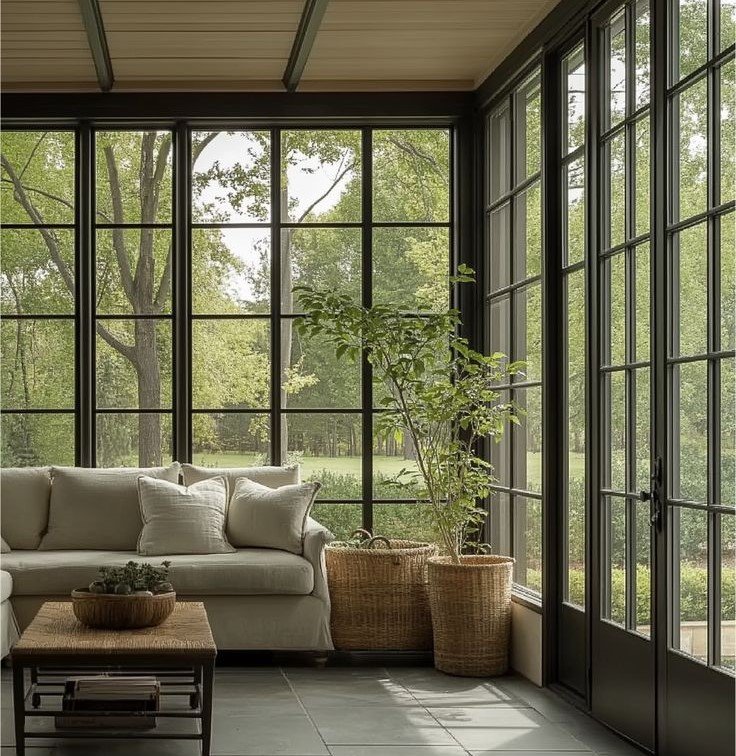
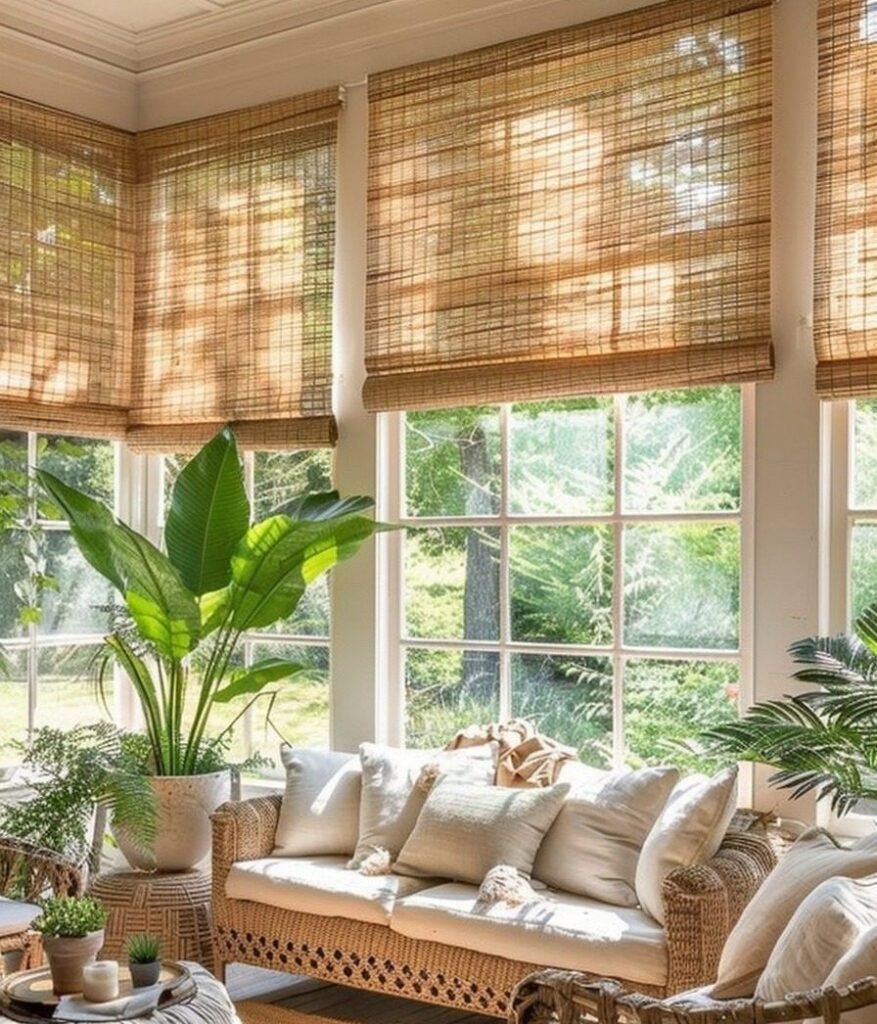
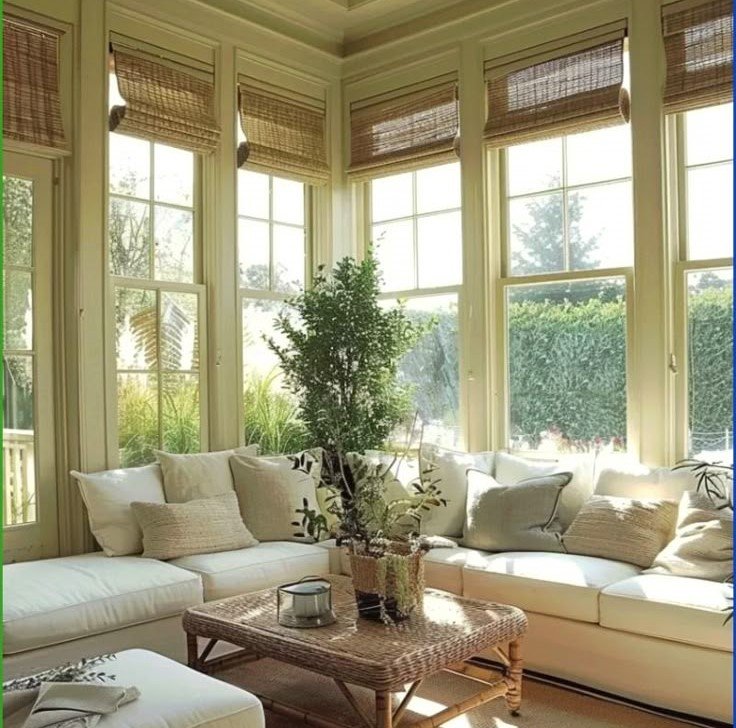
    The sunroom is the brightest space of your home. It brightens up your area like nothing else. Everybody has a beautiful and cozy sunroom idea on their home’s decor checklist. It somewhat puts your dream house together.

    If you are lucky enough to add a sunroom to your home or farmhouse, then you should be willing to spend an equal amount of time and effort on decorating it as well. It deserves all of your attention. If done right, it is one of the most magical spaces of your farmhouse and allows everyone to come and sit together for a memorable time.

    Sunrooms have the advantage of ample sunlight. Thus you don’t have to worry much about the lighting of the room. You need to focus on sunroom furniture ideas and brainstorm a lot of them to make sure that you are investing in the right things. Along with the perfect furniture, accessories play a huge role in bringing an incredible sunroom together.

    A sunroom can be used for almost everything. You can have breakfast there, or you can just sit together with your family and have meaningful and fun conversations. The versatility of this room is impressive. You can also make it an all-season place by adding texture, rugs, and blankets to it. A sunroom is not only for summers but can be used for winters, too, by adding the right elements to it. There is a lot that you can do with this room, and we are going to help you out on the journey. In this piece of article, we have compiled some excellent farmhouse sunroom ideas. These will help you in bringing together a beautiful sunroom that you have always dreamt about.

    Indoor Sunroom Furniture Ideas for your Farmhouse

    If you own a farmhouse, you must have a sunroom in it. Also, you should put in all the effort in it to decorate it the way it deserves. The right furniture and accessories, along with a beautiful color palette and really enhance the sunroom and make it look impeccable. Here are some indoor sunroom furniture ideas which are going to help you put together a dreamy and perfect sunroom!

    ● Add Chic Stools:

    To begin with, some modern farmhouse sunroom ideas, start with adding some sling styled chic stools. Folding stools make a great piece of furniture and can be used for multiple purposes. You can use them for eating or as accent tables as well. The best part about these stools is that they are easy to move around the farmhouse. They are super portable and add a very contemporary outlook to the sunroom. Place them at the foot of the more extended sofa, and they are going to be the cutest thing in the room.

    ● Make a Pot Station:

    As the sunroom is gifted with ample sunlight, you can add life to it by placing plants in it. Making a gardening hub corner in the sunroom is a beautiful idea. However, you need to make sure that you do not scatter plants all over the room. Designate a corner for the pot station and put some cute and vintage plant pots in there. Make sure that you invest in some beautiful containers so that they add spark to the sunroom. There are numerous indoor planting accessories that you can opt for. You can quickly get hanging pots and tables, which make everything look much more beautiful. Planters can transform everything impeccably.

    ● Enhance everything with a Statement Table:

    A good table is crucial in all the cozy nooks of the house. In a sunroom, you need to pay special attention to it. A statement table is going to turn your room into a chic one. An intricate pattern table is a show-stealer. Also, experiment a bit with the shape of the table as well. Ditch the square and rectangle shape and go different. Hexagon statement tables are breaking the furniture norms, and we have so many different shapes available these days. It all makes it easier to add an eclectic style to the sunroom.

    ● Make a Reading Corner:

    If you are a bookworm, then dedicating a corner, this hobby is a great idea. Also, a sunroom is one of the principal rooms of a farmhouse, and you are likely going to spend most of your time here. Therefore, create your favorite corner with all the effort that you can put in it. You don’t need large furniture for designating a nook for reading. You can invest in a stylish rug or small couch for this corner. Throw pillows are the best accessories to add to the sofa or your reading corner. With the addition of some chic and stylish cushions, you are good to go and read your favorite books.

    ● Drinks Station is a MUST:

    Your sunroom must have a drink station. Comfortable seating is crucial, but what actually takes it up a notch is a drink station. Buy a three-tiered drink cart and add your favorite drinks to it. Keep the cart stocked up so that when your friends visit, they have some of the best drinks at hand. Cheers!
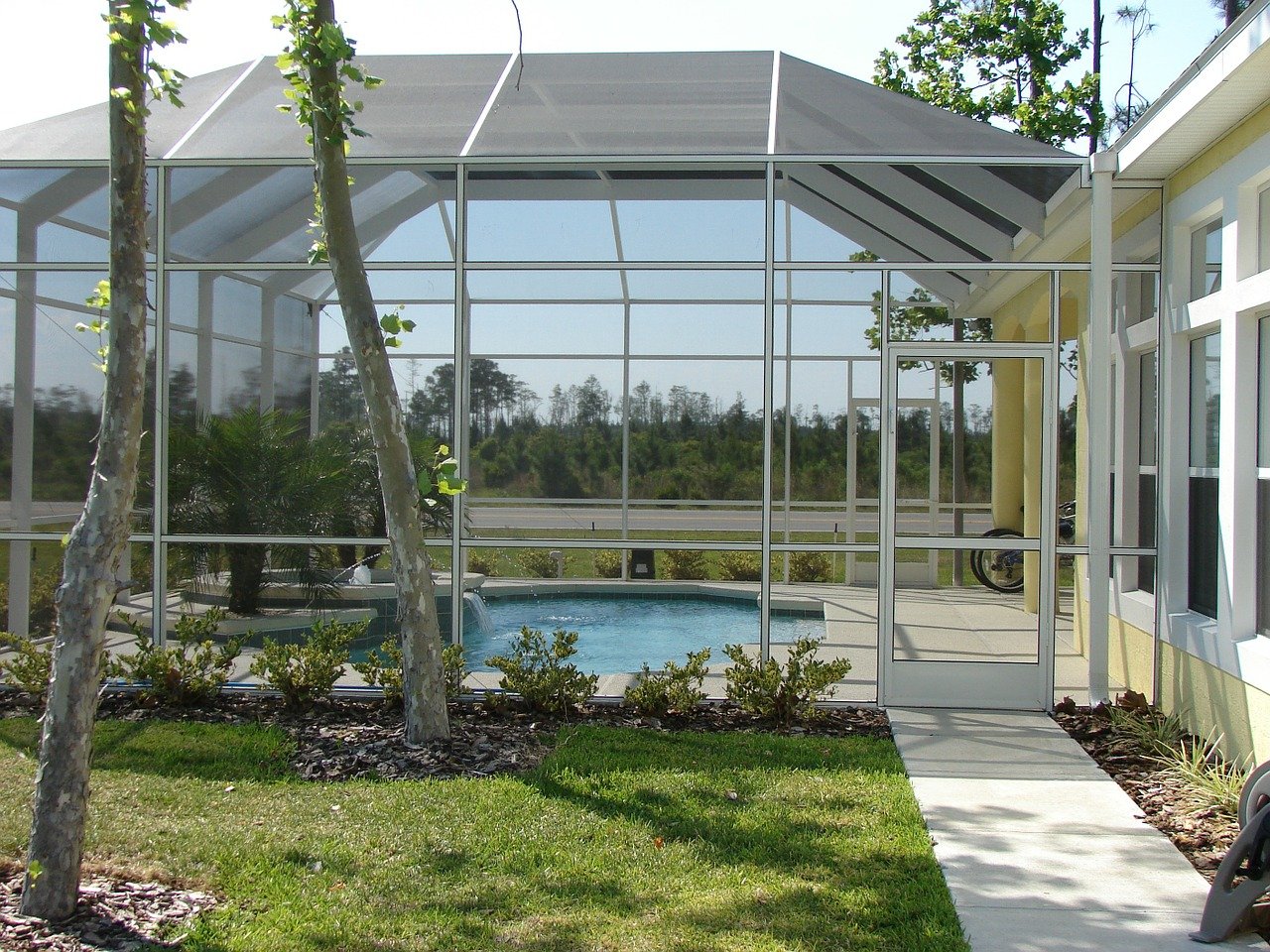

    ● A Plush Rug adds MAGIC:

    Plush rugs are everything these days. They enhance your furniture and make rooms appear better and prettier. Get a patterned plush rug and place it under your statement table. If the table is patterned, make sure that the carpet matches with it. Add contrasting colors or go for a pastel plush rug. Moroccan rugs are incredibly chic and spark up the overall room as well. Invest in a good one, and it will go a long way for you.

    There is a lot more than you can do to add magic to your sunroom. However, these ideas can really help you manage in decorating your room efficiently.

    Small Sunroom Furniture Ideas:

    Your sunroom doesn’t have to be huge. Yes, it does look perfect when it is vast, as it is the best nook of your farmhouse. However, you can still manage to put together a cute and small sunroom as well. We have some quick and easy small sunroom furniture ideas for you that will help you along the way:

    ● Opt for Smaller Furniture:

    A small sunroom is going to demand more miniature furniture. It is trickier to buy smaller couches and tables, but if you do it right, then you can easily create a cute little sunroom. The primary key while shopping for a smaller sunroom is to focus on more miniature furniture.

    ● Get a Rolling Table:

    A small rolling table is an excellent investment for a piece of more miniature sunroom furniture. You can move it around, and thus, you don’t need multiple tables or a huge one. Rolling tables are available in different sizes. You can buy the one that suits your room’s size. Also, pick the window you will like to put it beside.

    ● Combine your Pot Station and Reading Nook:

    With lesser space, you have to be smart while arranging the furniture. It does not mean that you cannot have it all in a smaller sunroom. If you love plants and you also want a reading corner, then you can easily combine both. Place a cute planter beside your reading couch or hang one or two plant pots along with the room. The best thing about hanging pot stations is that they do not take up your space. But you need to make sure that you do not hoard up with the planters. Two are best, but if you really want more than three is the limit. You don’t want your space to look crowded.

    ● Add repurposed furniture:

    For small sunroom furniture ideas, you can opt for repurposed furniture too. Flip a little basket and make a table. It is all about saving space and being smart. It will not only serve as a side table, but you can also add a little plant on it.

    Small sunroom furniture ideas are really easy to have fun with. You definitely need to be more selective and specific while investing in furniture and accessories, but if you do it right, then you can create a magical, cute sunroom!

    Sunroom Dining Furniture Ideas:

    Many people wish to combine their dining furniture within the sunroom, and this is a beautiful idea. In a farmhouse, you can either have outdoor dining or opt for indoor sunroom dining furniture ideas as well. Or you can have both. However, you need a large sunroom if you are eager to merge your dining furniture in it too. If so, then here are some really incredible sunroom dining furniture ideas that you can try out to make the dining look impeccable.

    ● Wooden Dining:

    Wooden dining furniture adds a lot of style to your sunroom. It makes it a cozy hub for dining, and your visitors will adore it. Add a little color to the table by placing pink or white florals on it. You can also place artificial ones as they do not require a lot of effort to be taken care of. Make sure that you add a pastel color table spread to bring in life. Trust us when we say that wooden dining furniture is vintage and chic. It will enhance your sunroom as nothing else will.

    ● Dinnerware:

    Your dinnerware is crucial to pay attention to when it comes to sunroom dining. Choose sets that have natural patterns on them and are light-colored. If you are going for plain dinnerware, then opt for neutrals shades. It adds a lot of natural ambiance to the dining. Specific dinnerware is extremely powerful, and it adds a lot of spark to your overall dining.

    ● Pendant Lamps:

    The staple accessory of good dining is a pendant lamp. It is one of the most stylish things that one can add to their dining. Find a lamp that is bright enough to light up your evening meals. Also, keep in mind the decor sense. Gold and rose gold pendant lamps are incredibly stylish, but you must take into consideration your overall decor while choosing it. Pick a lamp that matches the colors of your ambiance or at least contrasts well with them.

    ● Buffet Cabinets:


    Pendant lamps and dinnerware are crucial elements in your sunroom, but at the same time, buffet cabinets are essential too. They add style to your decor and enhance the outlook as well.

    Sunroom dining furniture ideas are limited, but if you focus on these basics, you can easily pull off a beautiful dining area within the room. It takes proper planning to put it all together, but you can manage it well by keeping in mind these essential furniture elements.

    CONCLUSION:

    Sunrooms are dreamy and magical, and if you create it with proper planning, then it is one of the coziest and most remarkable areas of one’s farmhouse. It adds charm to it. With these simple yet effective sunroom furniture ideas, we hope that you are able to decorate yours with care. From small sunroom furniture ideas to sunroom dining furniture ideas, we have compiled a short guide for you that will spark your farmhouse’s sunroom really well. Being one of the most bright and breezy places in your house, your sunroom deserves a lot of attention. Put the right amount of effort, and it will be your best corner to hang out in.
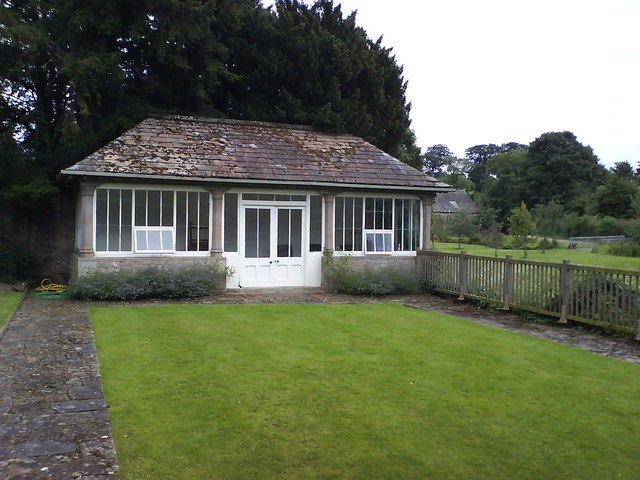
  • TYPES OF SUNROOM FURNITURE MATERIALS | THE BEST CHOICES TO MAKE

    When evaluating sunroom patio furniture, you need to look into various features. From the style to comfort and from durability to various other traits, you have a lot to consider when planning about different types of sunroom furniture material wise. The primary thing that makes it harder to buy sunroom patio furniture is the amount of sunlight it is exposed to all the time. The sunroom is naturally gifted with ample lighting, and the furniture is exposed to direct sunlight during the day hours. You obviously cannot get 100% weather resistant sunroom patio furniture, but some considerations can help you make the right pick. You need to pick furniture that can at least last longer with sunlight exposure. Therefore, you must know the variety of furniture and fabrics that can endure direct sunlight all around the year.

    Before making a decision, you have to understand the pros and cons of each type of furniture material that is accessible in the market these days. Knowing is going to help you in making a better decision for what aligns with your residence and sunroom requirements. Your commercial environment, your personal preferences, and style all need to be aligned to ensure that you are investing in the right type of furniture. Choosing the best examples of sunroom furniture material-wise is challenging, but you can easily make a good pick if you know about the pros and cons of each one.

    Types of Sunroom Furniture Material Wise:

    The truth is that we have an overwhelming variety of furniture materials these days, and they keep growing. It makes it harder to make a good pick. However, your lifestyle and home or farmhouse’s location plays a massive role in determining the type of sunroom patio furniture material you should invest in.

    Remember that investing in indoor sunroom furniture is a massive task. It is your most significant investment that you make after years and years. Therefore, be careful with the decision to make. And we hope that this piece of article is going to help you get the best for yourself.

    To begin with, the most commonly used sunroom patio furniture is;

    • Wooden sunroom furniture like cedar and teak etc.
    • Metal furniture like steel and aluminum or wrought iron.
    • Synthetic furniture like ABS and plastic etc.
    • Concrete furniture is also trending.

    Wooden Sunroom Furniture

    When it comes to wooden sunroom furniture, the most commonly bought material is teak. It is one of the most popular choices that people make when it comes to investing in sunroom patio furniture. And it deserves to be famous, for all the right reasons. Teak is considered perfect for all types of weather and has the ability to endure direct sunlight too. Thus, it is incredibly long-lasting.

    The aesthetics of teak are impeccable as it’s warm tones are appealing to the eye. Moreover, it is made up of natural resin, which keeps it safe from insects too. Therefore, teak is one of the most durable choices to make when it comes to wooden sunroom furniture. It is just perfect. Invest in a teak sealant too so that the furniture lasts for years. With time, teak does fade away into a shade of pale grey. However, it does not go with the vibe for almost everyone. A sealant helps make it last longer.

    Synthetic Resin Furniture:

    Synthetic resin is another fantastic choice to make for your sunroom patio furniture. It is durable, weather-resistant, and extremely lightweight, which makes it portable. It is woven together in a wicker style, which makes it perfect for outdoor and indoor sunroom furniture. A lot of people confuse synthetic resin with rattan sunroom furniture; do not do that. The outlook might fool you, but this material is not rattan. Rattan sunroom furniture is not right when it comes to enduring harsh sunlight. Thus, it is not a great choice to make. Invest in synthetic resin furniture, which has HDPE wicker in it. It is the most reliable synthetic furniture to get.

    Synthetic resin is known as wicker too, and there is some incredible white wicker sunroom furniture available in the market these days. White wicker sunroom furniture looks extremely classical, but it does not withstand moist weather. However, it can last for a reasonable amount of time in an indoor sunroom. But overall, white wicker sunroom furniture is not the best choice to make.

    Metals:

    Gone are the days when wrought iron was a popular choice for people to make. As it is cumbersome, it is not bought these days. Thus, aluminum and steel are the most commonly used sunroom patio furniture nowadays.

    To begin with, aluminum is extremely durable and lightweight, which makes it portable and user-friendly. Moreover, it is an attractive option too. With very fewer maintenance requirements, aluminum stands out in metal furniture. Secondly, steel is another right choice to make when it comes to sunroom patio furniture, but due to its heavyweight, it is not used much now. People prefer to keep it outdoors completely.

    FURNITURE FABRIC MATERIAL TO OPT FOR:

    Wooden and rustic sunroom furniture is the most commonly bought furniture type these days. Whether it is for an outdoor or indoor sunroom furniture, people adore the appeal of wood, and it is long-lasting as well. Now that we know the most common types of sunroom furniture material-wise, we are going to look into the variety of fabric materials as well. Which fabric is best for upholstery? Which fabric can withstand sunlight? We have it all summed up here for you.

    ● Acrylic fabric:

    Acrylic fabric is the best option for your sunroom patio furniture. It is extremely user-friendly as it is weather resistant. It does not fade away with sunlight exposure and doesn’t wear off with extreme use either. Thus, it is a good investment. The fabric is solution-dyed. This means that the threads are dyed before they are weaved. Therefore, the color and the textile pattern on acrylic fabric lasts longer and doesn’t fade quickly. This is a breathable and water and sun resistant fabric, which is why it makes an excellent choice for your sunroom patio furniture upholstery etc.

    ● Polyester Fabric:

    Polyester is a synthetic fabric, and it is coated with vinyl or acrylic for extra protection. It is a durable, flexible, and strong material that can withstand various weather conditions. Thus, it is a common choice made by people when they have to invest in wood sunroom furniture upholstery for cushions, etc. However, there is one disadvantage to this fabric; it fades faster than acrylic. It is not solution-dyed, and thus, the colors tend to turn to a pale shade. But they will last you for a year or more maybe. But due to its durability towards various weather conditions, this fabric is appreciated a lot.
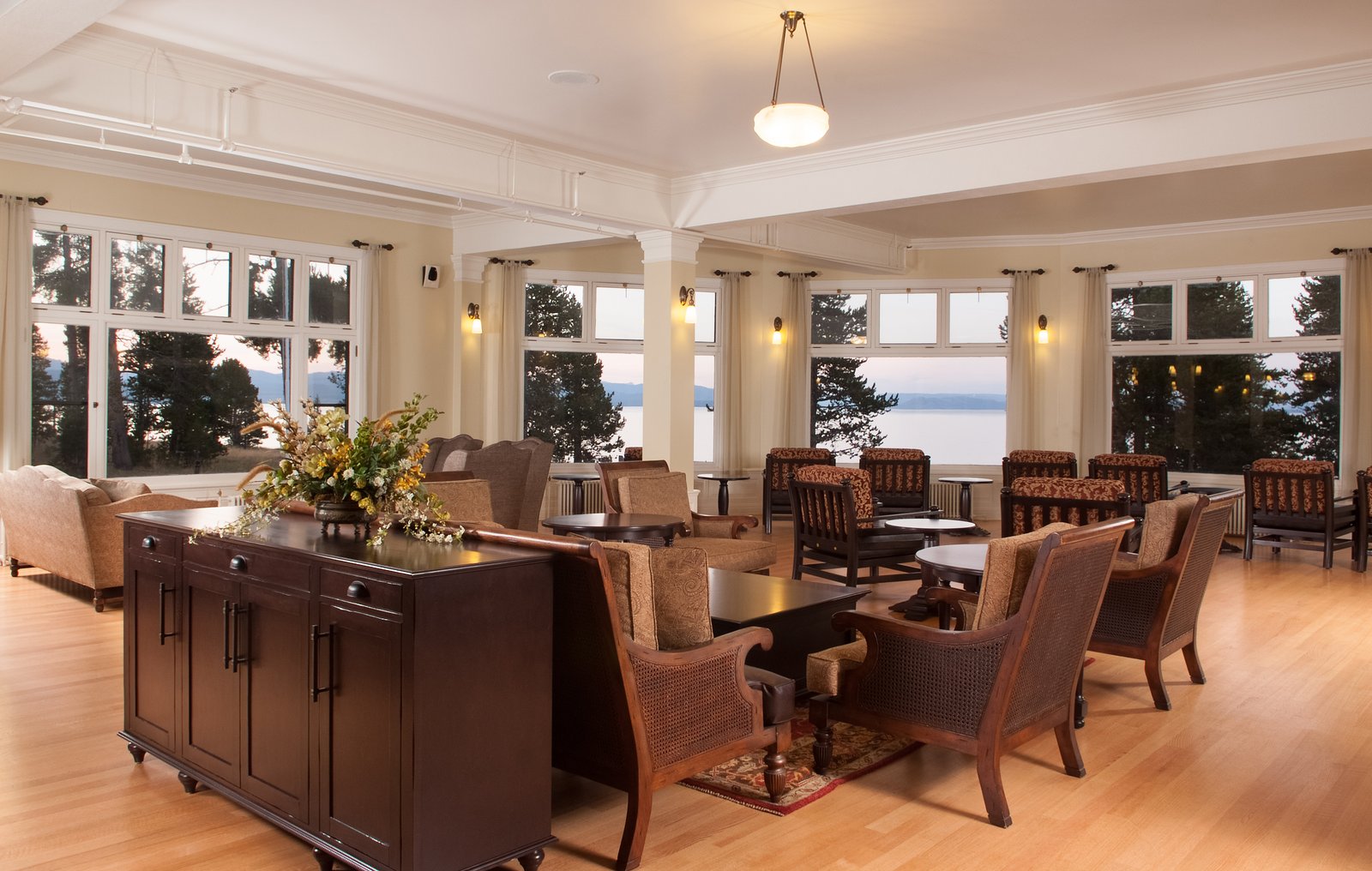
    FINAL VERDICT

    We have summed up the most common types of sunroom furniture material wise. Wood sunroom furniture is one of the best ones to opt for, with teak being the best option. Aluminum is also an excellent choice to make if you are not very conscious about aesthetics. Acrylic fabric tends to be the best pick for sunroom patio furniture. We hope that this quick guide has helped you, and you will be able to make the right choice now. It is a considerable investment; thus, think before you leap.
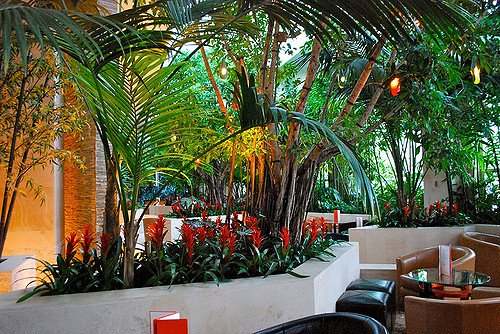
  • Casual And Comfortable Sunroom Furniture Ideas

    Anyone who has a sunroom in their house, definitely knows that it becomes one of the most favorite corners for you, within a short time. It is not that hard to adore. Summers bring the most out of this room as it is gifted with ample natural lighting, which adds up to its coziness really well. It makes it one of the most comfortable spaces in your house. Unwinding from a hectic day, in your sunroom, with your family is the definition of a picture-perfect family.

    The idea of sunrooms was generated in the 17th century, and since the 19th century, they have gained a lot of popularity and love. The idea evolved through indoor porches and gradually grew. With time, they have modernized so much that you can never get out of ideas for decorating your sunroom.

    Now, as people usually say that owning a sunroom is a “dream.” partially, this is true. You need a vast space to dedicate to the sunroom, and a lot of thought and different glass doors and windows go into it. Also, as you will approach the internet, looking desperately for decor ideas, you will be lost in a swarm of them. Where all the best sunroom furniture and decor ideas will make it seem like owning one is out of your affordability, we are here to assure you that it is possible. You can put together a smaller, much casual and affordable sunroom. Yes, it might require you to plan a lot, but it is not impossible. And we are here to help you as well.

    This piece of article is entirely dedicated to some of the best sunroom furniture and decor ideas. We are sure that you are absolutely going to fall in love with these!

    Indoor Summer Furniture Tips to Remember:

    When you are planning to invest in indoor summer furniture, you have to keep in mind that it should have the ability to withstand extreme conditions. Your furniture is going to be exposed to excessive sunlight, and thus, you have to put in a lot of consideration. Therefore, keeping your indoor summer furniture in good condition is crucial. And you have to pay attention to it.
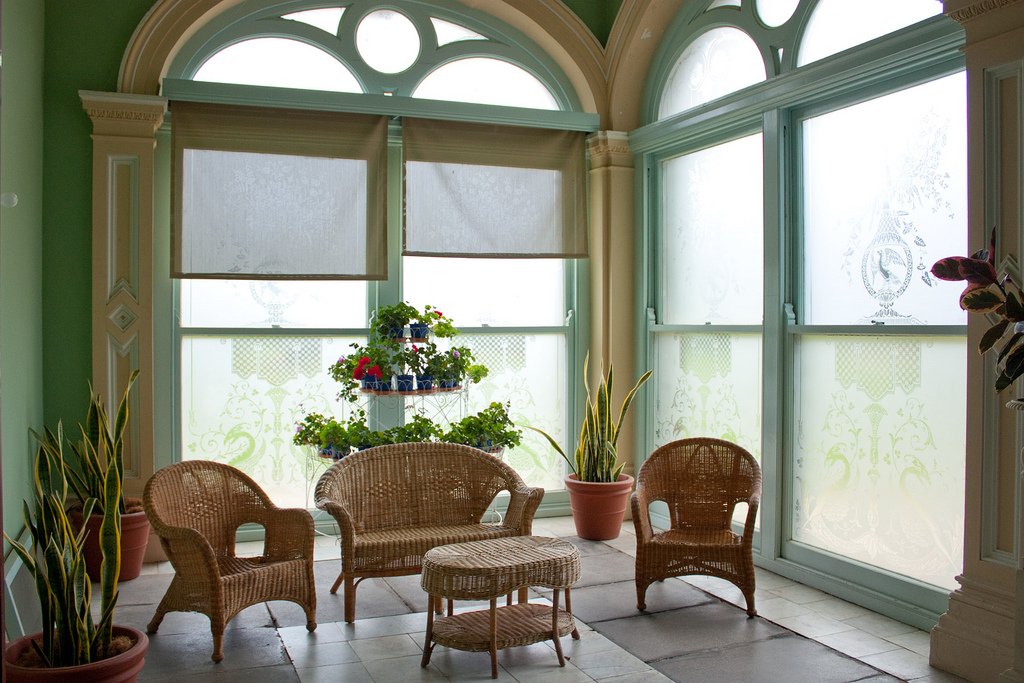
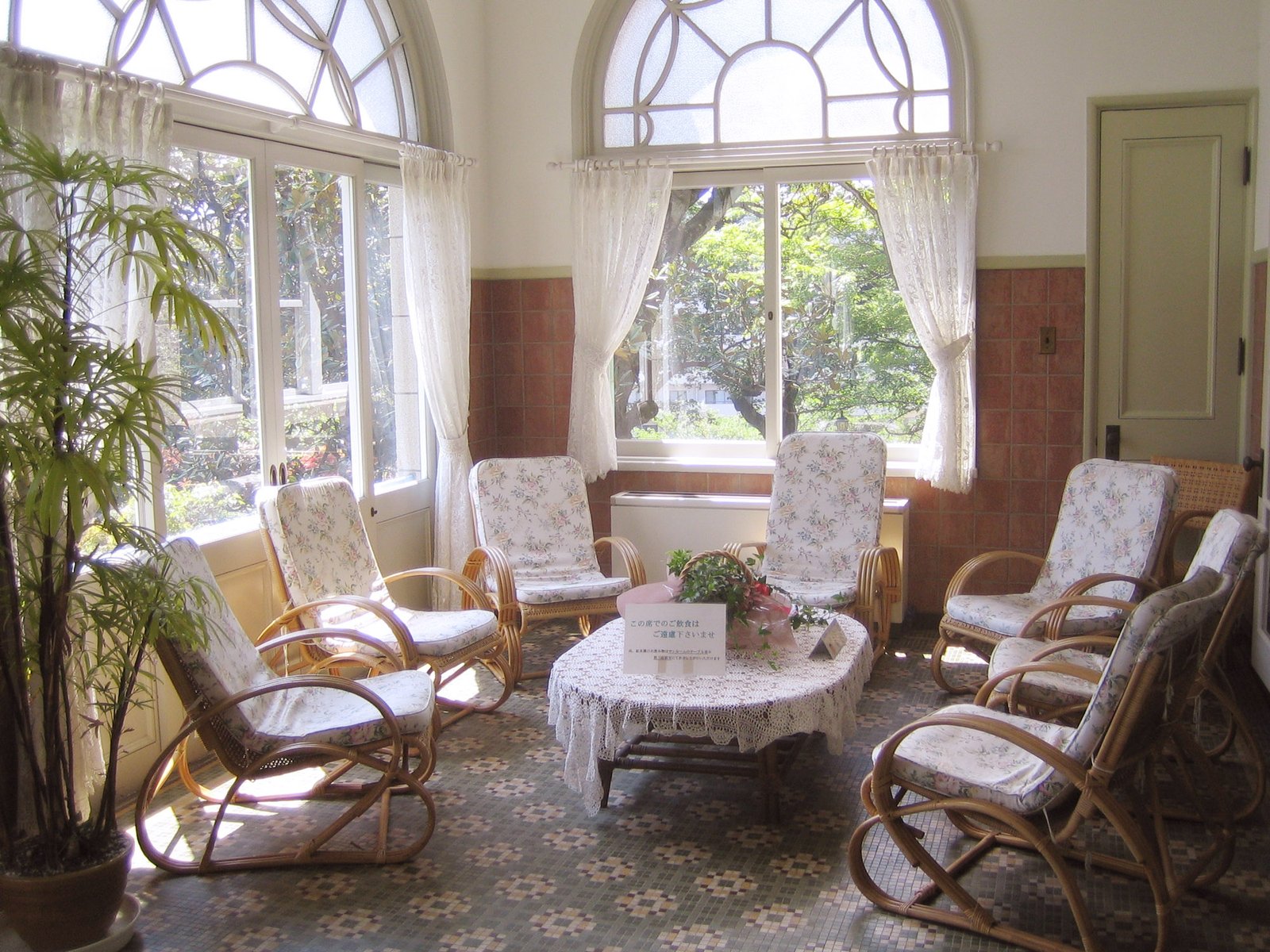
    The best tip that we can give you here is to buy outdoor furniture. For instance, if you are placing a rug in your lawn, it must be able to endure sunlight and last for at least a year or two. Similarly, when you are investing in a rug for your sunroom, you need to consider the excessive sunlight it will have to endure. You need a fabric that can withstand it and last long. Therefore, invest smartly because you want the best sunroom furniture which not only “looks” good but is worth the money.

    Another tip to keep in mind while you shop for your indoor sunroom furniture is that you must have it all planned beforehand. You do not want to be lost in a pool of inspirations which are all parallel from one another. Some people like to create a vintage outlook of their sunroom, and many want to keep it casual. You need to decide the “vibe” of your furniture because you will be investing in the furniture and accessories accordingly. Putting all your ideas together is crucial before you start shopping. Having an image of what you wish to avail at the end is going to help you massively.

    Sunroom Ideas on a Budget; Affordability is CRUCIAL

    As mentioned above, many people can only “dream” about a sunroom and not own it. A sunroom is a transitional and beautiful space; there are endless possibilities of what you can do with it. However, looking for things on a budget is always a good idea. If you don’t have a pool of money to spend on your sunroom, it is completely fine. We have some sunroom furniture affordability types and decor ideas that will help you remain on a budget but make this space as beautiful as ever.

    As sunrooms have natural sunlight oozing in, you don’t have to spend on lavish lighting at all. You need considerable windows to let the sun do its job. We are not saying that you can quit the idea of lights overall. You obviously need to invest in them, but you can obviously stay on the affordable edge, and a few will do the job well. On the other hand, if you intend to use this room only during sunny days, then you can skip the lights and enjoy the free, natural sunlight.

    Secondly, limit your furnishings. There are various sunroom furniture affordability types, and they are really simple yet chic. You can always go for simpler things as minimalism is the new fashion. Invest in miniature furniture and a small coffee table. Flip baskets to make side tables if you really want to. Get smaller rugs and cushions, and you are good to go. Do not plan to make your dining within the sunroom if you are on a budget and are looking for affordable items. Just make it a cozy room with huge windows where sunlight is creating the ambiance on its own.

    A plush couch is one of the coziest pieces of furniture one can invest in. You can quickly get a comfortable one for around $200 or even less. If you are looking for cheap sunroom furniture, then make sure that you do not compromise on quality. This is anyways going to be the right amount of investment, thus take something long-lasting.

    You can also ditch the idea of adding a huge and expensive TV in the sunroom. The primary aim of this space is to hang out with your friends and family to spend quality time together. Thus, all the high-tech stuff does not go in there. A lot of people add these things but sticking to the essence of the sunroom; you don’t need it. Also, it will help you stay on a budget too.

    Comfortable Sunroom Furniture; How to make the Space Cozy and Comfy?

    Your sunroom must be comfortable and cozy; there is no way out of it, and your furniture plays a massive role in it. Buying comfortable sunroom furniture is crucial, which is why we have stressed upon not compromising on quality ever! Every perfect sunroom has the most suitable furniture which sets it apart. And then obviously, the way it is set adds the spark to it. Therefore, we have compiled some comfortable sunroom furniture ideas that will help you in making your space cozy and comfy for everyone and that, too, within a budget.

    The modular furniture setting is exceptionally chic and comfortable. It is also a casual sunroom furniture style, which lets you keep your sunroom casual and chic. Take modular sofas with hip cushions to ensure exceptional comfort and coziness.

    • As leather sofas are incredibly comfy, many people opt for those. Yes, we adore them too, but excessive sunlight is not going to let them last long. If you are not going to place them in direct sunlight, then you can certainly go for them.
    • However, plush seating is another great idea to add comfort and coziness to your sunroom. It makes your sunroom appear casual and very stylish. A lot of modern sunrooms have plush seating in them now, and they look incredibly unique. Go for brighter colors or neutrals shades with patterns on them so that they enhance your space.
    • If you have bought the best sunroom furniture, then the next thing that will play a massive role is the way you arrange it. Your sunroom should give a vibe of warmth and cheerfulness. So, arrange everything properly. Planning is the best because it will also help you in buying the right indoor sunroom furniture.

    Your indoor sunroom furniture needs to be comfortable and cozy. Investing in the best sunroom furniture will allow it to run for years to come. You can find cheap sunroom furniture too these days, but it won’t be long-lasting. It is better to buy less or miniature furniture so that it doesn’t ask for much investment. But never compromise on the quality and comfort.

    Say NO to Cheap Sunroom Furniture:

    Before we proceed with more ideas, we would like to emphasize on the importance of dumping the concept of buying cheap sunroom furniture. The reality is that furniture is an investment. No matter what you do, it does require the right amount of money. Staying on a budget is excellent, but choosing cheap sunroom furniture is not a right or sensible decision to make.

    Firstly, you can opt for minimal furniture. Do not hoard your sunroom with couches and sofas and tables. It is not necessary. You can stay minimal and straightforward and still manage to make your sunroom look perfect. Secondly, you can choose the miniature furniture. It costs less and looks cute and casual as well. If you want your sunroom’s vibe to be relaxed and warm, then small furniture is a significant investment. Thirdly, you can wait for discounts. Every furniture company offers promotional discounts or end of the season or year discounts as well. You can look up to those and save a lot of money. It allows you to stay on budget without compromising on the quality. Isn’t that amazing?

    Our aim here is to let you understand that cheap sunroom furniture is not an option. It won’t only make your sunroom look tacky but will also require up-gradation now and then. Instead of investing in chunks, you should buy a quality product for once. Building a sunroom is no joke, as it takes a lot of time and effort. Thus, opt for other options but do not invest in cheap sunroom furniture at all.

    Ideas for Casual Sunroom Furniture and Decor:

    Casual sunroom furniture and decor can enhance this space and make it super friendly. Your furniture plays a massive role in shaping the area more casually. But the arrangement can make a vast difference as well.

    To start with, your casual sunroom furniture should be suitable for your space. Plan how you intend to utilize your space beforehand. Do you want it to have dining, or you just want it to be a casual and cozy corner of the room? Do you want to make it a perfect “sit and talk” area, or you want it to be entertaining? Your needs will define how “casual” your sunroom can be.

    Secondly, the casual sunroom furniture should vibe with the environment you’re trying to build. For casual sunroom, you can go for patterned fabric and plush cushions and cozy rugs. These accessories will not only enhance your furniture but will also create a very casual and lovely vibe overall. Avoid using leather furniture for your sunroom, and make sure that you choose the fabric for your casual sunroom furniture carefully.

    Your personal style is extremely crucial to keep in mind while you plan your indoor sunroom furniture and arrangement. Your preferences will make it easier for you to set up this space. Everyone has their definition of “casual,” and you must go with yours. It will not only make the process easier for you, but it will also make it quicker. A place is casual only when it is cozy and personal to you. Therefore, plan before you implement and invest.

    How to Plan for a Four Season Sunroom Furniture?

    Now your sunroom won’t be used during the summer only. It is an all-season room, which is undoubtedly utilized more during the warmer days due to excessive sunlight exposure. But there is a lot that needs to be planned before you invest in four-season sunroom furniture. You need it to be cozier for autumn and winters, and you also want it to be bright and sunny because that is what a sunroom is made up for. So how do you do that? Here are some tips and thoughts for four-season sunroom furniture and decor. We hope that this helps you make a smart investment.

    • Firstly, the most primary thing to keep in mind is that you have to utilize this room all around the year. Sunlight exposure is going to remain throughout, being minimal during winters. However, as mentioned before, you need to invest in furniture that lasts long. Therefore, always look for furniture that can endure sunlight and can last for years.
    • The fabric of the furniture is the second element to pay attention to while you are planning for a piece of four-season sunroom furniture. Buy thicker fabric furniture. Similar is the case for cushions and plush pillows. The fabric should not fade rapidly due to sunlight.
    • As the sunroom is gifted with ample natural light, you can easily add plant pots here. There are so many plant furniture or accessory items available these days that you can never get out of options. From hanging pots to standing ones, and from small to huge ones, you can get anything that you like. A four-season sunroom would look perfect with some plants in it. They are going to add life to the ambiance.
    • Another element to consider while you are buying four-season sunroom furniture area rugs. They add warmth to space and will help you stay cozy during the autumn and winter seasons. The addition of throw overs on the sofa or couch can add a lot more warmth for the colder weather. Thus, do not forget these furniture accessories.

    While planning and investing in four-season sunroom furniture, you must keep all the seasons in your mind and invest accordingly. Do not just shop according to the current season or summers; you will love this space, and thus, it will be used the most as well.

    Luxury Sunroom Furniture Ideas:

    Some people love the idea of a luxury sunroom and wish to make it a bit extravagant. If you are one of them, then we have a couple of luxury sunroom furniture and decor ideas for you right here. With the help of these, you will be able to make your sunroom look elegant and luxurious. Also, these are certainly going to demand for a huge budget; thus, plan accordingly.

    • Country House Sunroom Vibe:

    If you wish to make your sunroom luxurious yet minimal, then you can try setting it up in the country house sunroom vibe. Make sure that you extend the sunroom towards the backyard so that the view is earthy. Also, a pale green palette will add the perfect vibe to it. A little research will help you understand exactly what needs to be done to attain the ideal country house sunroom.

    • Go with Black and White:

    This is another minimal yet extremely luxurious palette to play with when you are planning your luxury sunroom furniture and decor. Black and white make everything look classy and elegant. It adds a spark to the entire ambiance, and that is exactly what a luxury sunroom should look like. Play around with these two primary colors, and you will be able to create a beautiful sunroom that not only looks luxurious but also appears to be elegant and classical.

    • Try it all white:

    White is the perfect luxurious color, and if you want to set up a luxury sunroom furniture and decor, then you can take the chance of going all white. Yes, it is pretty tricky, but if you put in a lot of thought and planning into it, then it can turn out to be incredible. You can make the luxury sunroom furniture all white and pop a bit of color with pastels through cushions, rugs, and vases, etc.

    CONCLUSION

    There is a lot of thought and process that goes into planning a sunroom. It is undoubtedly one of the most expensive spaces to decorate, but you can always go with an affordable and casual look too. All it requires is proper research and a bunch of ideas regarding what would be perfect for doing with this space. Your indoor sunroom furniture needs to be bought with a lot of planning and thought and make sure that you do not buy leather couches or sofas. We hope that these simple yet helpful tips and ideas help you out in creating a beautiful sunroom. Whether you are building a casual or a luxury sunroom, these ideas are going to be your best buddy throughout the journey. Make sure that you plan everything out beforehand so that the process becomes easier and quicker. Planning will help you in arranging your indoor sunroom furniture impeccably well. To start today and we hope that your sunroom will turn out to be amazingly beautiful and will become your favorite book of the house, within no time.

  • Small Sunroom Ideas- Cheap Ways to Decorate Sunroom

    It is fact that sunrooms are structures either attached or combined into the house to allow you enjoy the surrounding landscape and environment. They always shelter from the bad outside weather and are perfect for any weather zone. Small sunrooms are a perfect place to relax while enjoying a view of a surrounding, reading a storybook, and meeting with friends, get to gather with family, or even to sleeping. If you don’t have enough space for a sunroom, here are some small sunroom ideas.

    Small Sunroom ideas

    Incase you are planning to design from scratch, it is a great idea to include at least a small sunroom into your home. If you already have a home, do not get upset. You can always build a sunroom addition that would even better because it would have a glass roof and a great view of your established garden.

    Among the various curls that you can give to your sunroom, one is to change it into your workstation. You can place a table and a chair along with a comfortable sofa may make it a perfect place for you to work from and study as well. Apart from the natural atmosphere, your personal touch to the small sunroom styles would only add to the appeal.

    Small Sunroom Ideas- How to Choose Style

    There are many ways to decorate small sun room in the home. In small sunroom we can arrange, small friends circle party, family get to gather and etc.

    Decorating Style 1

    Sunroom Furniture

    People have mostly used sunrooms for rest and relaxation. It is compulsory that sunroom environment meets the requirement. Furniture of a sunroom is the best way to create an environment and a hanging daybed is a perfect furniture choice for a decoration of small sunroom in a home.

    Decorating Style 2

    Sunroom Pool

    Decorating Style 2

    Yes, it is an awesome style to make an indoor swimming pool with gorgeous tiles and vases. With this style, your sunroom looks different and attractive. This style takes a bit larger area in the sunroom but it will make a beautiful place.

    Decorating Style 3

    Entertainment Zone for Kids

    Entertainment zone style only refers to that sunroom which is fully protected. If your small sunroom is fully protected from the basic needs, then you can easily include children indoor play area to entertain and you can create separate portion for older, youngster and children. You can also include in your style indoor-only items, such as lamps, stereos, and LED-TVs.

    Decorating Style 4

    Use Stylish Blinds

    Decorating Style 4

    You can use blinds for windows for making styles and in a case when you are disturbed from sunlight. Stylish quality window blinds are easily available in the market.

    Decorating Style 5

    Glass Roof and Windows

    Decorating Style 5

    To make a stylish small sunroom in a home make a roof and window with glass. Glass roof and windows to a back patio and you got yourself a beautiful orangery!

    Decorating Style 6

    Wood Burning Stove

    Wood Burning Stove

    Wood burning stove in small sunroom makes a different style of others. The super convenient sunroom filled with natural wood and a wood-burning stove is elegant. Many times sunrooms are concerned with inward comfortable sitting areas, dining spaces, or other living arrangements. A few pillows, a decorative rug, a simple statue, keep distractions to a minimum.

    Decorating Style 7

    Climate of Surroundings of Your Sunroom

    Decorating Style 7

    Most people do not desire to give up the use of their small sunroom when spring and summer weather is over. You can use your small sunrooms to make a great place for TV rooms and reading nooks in the colder months. You can always bring in a portable electric fireplace or heater and some warm decorative tosses for adding warmth.

    Decorating Style 8

    Attractive Flooring

    Decorating Style 8

    You can make your floor with best designs to attract to your family members and friends in sunrooms.
    Flooring in sunrooms naturally contains concrete, brick, wood or tile. You can also add colorful textures in your sunrooms rugs area. Tricky floor designs, such as medley tile or block patterns, are best left uncovered.

    Decorating Style 9

    Plants

    Decorating Style 9

    Many plants blossom in sunrooms. They naturally filter the air and truly bring the outdoors in. Popular plant choices are best for sunrooms to include begonias and African violets, which are equally low maintenance and produce colorful blooms year after year. You can also choose peace lilies for greenery to your sunroom. They grow tall, fill space in corners and balance larger furniture pieces. Your sunroom can be a place of joy and despite not only for you but also for your family, friends, pets and plants.

    Decorating Style 10

    Always adopt Formal Aesthetic Style

    Decorating Style 10

    For more traditionally minded and styled home, a casual small sunroom may feel out of place. Instead of, it is the best to continue the same atmosphere in finishes and fixtures. With large banks of windows, this sunroom is awash in light. Classic furniture lines and patterns, as well as decorative infections including the chandelier, maintain the formal feel.

  • Sunroom Furniture Ideas- A Comprehensive Guide to Sunroom

    A sunroom in your home depicts that how creative you are in your thoughts. We all know one’s mind need comfort and serene environment at a particular time in a day. This room has great importance if your house absorbs enough sunlight facing your home.The sunroom is one word, and there are no segments of this word. This sunroom is a place in your home where you can sit and look at the landscape surrounding your home whether its sea, greenery, backyard sea shore view, mountains or any other. Let’s start our comprehensive article about the sunroom where you will find sunroom furniture ideas, types, maintenance and much more.

    Sunroom Furniture Ideas

    The fundamental purpose of this room is to create a space in your home where you can experience some great scenery or absorb sunlight in a shelter without bothering to adverse climate. You are sure, a fortunate enough to have this room in your home which could be one of the best room in your home.

    The sunroom was first idealized in the 17th century. However, it got fame in the 19th century when the material used in this room became budget friendly. The installation equipment in this room was previously wood. Now, the entire concept of sunroom has changed to its best, and one can imagine a sunroom as a luxury space in a home.

    Types of Sunroom Furniture

    Sunrooms are usually known as glass or screen rooms. Solariums suppose to have big wide windows with a high ceiling; here we will discuss some different types of sunroom for your better understanding. If you are looking forward to upgrading your sunroom looks, make sure you follow some of these interior design ideas to bring a glam factor.

    1. Modern Sunroom Furniture Ideas

    Modern sunroom does refer to the concept of modern furniture. Although, the installations usually remains the same, however, the furniture gets an edge on these types of sunrooms. The conservatories which fall in this category usually got high-end furniture with cutting edge technology. A modern fireplace, it could be hanging or in a fireplace frame. The separators and ceiling are made of glass and sleek steel panels which make worth of its appearance to double.

    Modern Sunroom Furniture Ideas

    In some modern sunrooms, fireplaces are missing, and ceilings are at a normal height, but the accent furniture products make this space even more worth time spending. Elegance in its furniture speaks loud of your interior design aesthetics.

    2. Rattan Garden Sunroom Furniture Ideas

    Rattan is a form of timber, which grows in the northeast of Asia like the Philippines where average rainfall is 80 inches. This grows in a horizontal direction but a tangled form. This is one of the finest timber used in the furniture due to its durability and beautiful bending characteristics.

    Rattan Garden Sunroom Furniture Ideas

    Now for sunroom space, people wants to design and accommodate furniture made of rattan timber. This wood is sunlight proof and harms nothing to it except physical wear and tear. The old vintage furniture material is the best option to glorify your sunroom with its accent pieces. You can go online to get your hands on rattan garden furniture for your sunroom. The versatility in this furniture pieces is commendable as these items can easily combine with other decor ideas.

    3. Wicker Sunroom Furniture Ideas

    Wicker wood furniture compliment sunrooms in all right ways. The wicker is itself anonymous to its existence. However, it is a processor design made by combining different furniture wood types like rattan, bamboo, cane and other such materials. These forms of wood are made wet so that it got easier to weave Wicker furniture designs.

    Wicker Sunroom Furniture Ideas

    These designs are versatile and can be placed in any space of your home. You can make your winters warmer and cozy by accommodating such plaited and woven wicker designed furniture in your sunroom. Reds, dark green and even dark rust shades cushions and seating on this furniture will bring more warm effect to your conservatory.

    Preppy wicker. You cannot turn out badly with an essential coordinating wicker furniture set (loveseat, rockers, and glass-beat foot stool) on the sun porch; the adornments can separate it. Give your furniture. Simplicity that all matters. Don’t overthink or over accessorize your sunroom. A beautiful and straightforward plan is all that is required, as in this to some degree nautical blue sunroom.

    4. Patio Sunroom Furniture Ideas

    Patio furniture does have an aluminum material in it which prevent it from rust. This furniture type usually conceptualized for an outdoor purpose, feasting, cocktail parties and get-togethers. We can make use of patio furniture for sunrooms due to its equal importance in a yard with a ceiling. This is most commonly used furniture type in different cafés restaurants, and other rooftop venues. Due to its high weather resistance capacity, it has a great price, and you have to go pocket full while buying patio table and chair for your sunroom.

    Patio Sunroom Furniture Ideas

    Not every patio furniture is made up of similar materials; you can choose according to your preferences regarding material choice. It could be in wrought iron. Wood, wicker, rattan. Teak and other weather friendly material.

    5. Bamboo Sunroom Furniture Ideas

    Bamboo wood has always been our favorite wood material for casual furniture items. We used to see our grandMA weaving bamboo fruit baskets in our childhood. That creativity is lost somewhere, and now machines have taken over the human’s skillful hands. Bamboo is one of the most commonly used wood materials and has great importance.

    Bamboo Sunroom Furniture Ideas

    As simple sunrooms usually consist of simple yet rustic wood furniture and for that purpose, we suggest bamboo furniture for the sunroom is the best choice one can make. The original furniture of the seventies, produced using unmilled bamboo shoots and posts, is as yet accessible. Processed, sanded and completed bamboo furniture matches any hardwood furniture in sturdiness and magnificence.

    This furniture type can be placed in different areas of a home, for instance, from a porch to garden to even sunrooms. You can set two chairs centered with one coffee table wrapped in comfortable foams. If your sunroom is facing to the deep sea coast, bamboo furniture will work best in the shelter.

    How to get Cheap Sunroom Furniture

    High-quality accent pieces are not cheap and readily available at high prices. Going for cheap furniture for your home will result in not more than disappointment. It is better to spare some extra bucks which work best for you for a long time.

    One has different options to buy a cheap furniture. Custom made, or high quality refurbished furniture. Custom made is bargainable while refurbished ones are cheaper than ready-made in the stores. Make sure; you have the best vendor who has the best workshop of highly skilled craftsmen.

    How to get Cheap Sunroom Furniture

    It is hard to know where to draw the moral line in the current monetary atmosphere – would it be advisable for us to help stores to remain above water, or exploiting the massive investment funds to be made?

    Enormous retailers have been hit hard by few individuals moving home and are being compelled to offer tremendous value cuts. In any case, and also searching for customary rebates there are different approaches to outfit your home for less.

    Independent furniture stores

    It may be simpler to go to a High Street chain, and you may think they have the best arrangements to offer, independent furniture stores makes customized furniture on your demand and charge more. A similar exhortation applies to online shopping when it comes to its delivery charges. I would suggest that independent shops have their importance in carving a furniture of your choice and material. You can select a material by your own and instruct them to make accordingly.

    How to maintain the sunroom furniture for a long time

    Amid the mid-year months, your solarium’s furniture gets lots of usages. On the off chance that you live in a place that has a cool or wet atmosphere in the winter, you should ensure that your sunroom furniture is appropriately shielded from harm.

    How to maintain the sunroom furniture for a long time

    The days are short in winters which mean less sunlight exposure, and there’s a chill noticeable all around. Since you are not spending your time near hearth in the sunroom, it is better to set up your furniture for the winter months ahead. With open air living spaces turning out to be more well known than before, most people have not less than a couple of pieces that should be put away. Indeed, even furniture that is dealt with to be climate safe or is under a porch cover should be looked after and kept up. Furniture needs maintenance, and it may lose its worth.

     How to maintain your Sunroom Furniture for a long time- Prime Steps

    1. Clean it up

    If you want to store your furniture in the winters, you may apply these steps while preparing to store them. The most vital part of storing furniture for a season is to get it clean. Dampness and dirt left on the exposed things and can cause different harm or damage during the winter months. Mold can grow and spread rapidly, moving your furniture could be better when you are prepared to utilize it once more. Furniture items made up of wicker, iron, and plastic can be cleaned with a basic dish cleanser and water liquid.

    2. Cover your furniture with a cloth

    Furniture spreads/covers are incredible for extra assurance from damage, regardless of the possibility that you are putting away your furniture in a shed or carport. These covers come in an extensive variety of sizes and weights, contingent upon whether you will store things outside or under cover. We found a few choices to suit needs. You can go online to buy furniture covers from Amazon or even from your nearest furniture stores.

    Cover your furniture with a cloth

    The table and chair covers are a practical approach to cover your entire table set. Accessible in two unique sizes, it highlights versatile circles to secure it to the legs, and a flexible rope in the base sew.

    Sunroom Furniture Ideas- The Decorating Guide

    Get enlivened with smart design and lovely textures, furniture, and accents to change your sunroom into the most rustic space in your home. Here’s a guide to decorating sunroom furniture.

    Sunroom Furniture Ideas- The Decorating Guide

    1. Add entertainment elements

    If your sunroom is completely shielded from the components, then you can without much of a stretch incorporate indoor-just things, for example, lights, stereos, and TVs. Introducing the last two can help attract family and friends to more in the sunrooms at evening, permitting you to maximize sunroom hours. Here, a diverse blend of highly contrasting colors like black and white, red and white, blue and white and any vibrant colors for your summers would be the best choice.

    2. Adapt spare window as decorative wall space

    If your sunroom has more than one entrance door, one of which was seldom used. What it did not have a wall space by the arrangement of different elements. It could be anything from couch or piece of art. Here is an option, which you can utilize while being creative. You can place a sofa or couch at the front of the spare door to create more seating plan than usual.

    3. Use blinds if sunlight becomes disturbing

    There are various distinctive types for the sunroom. If your sunroom has more sun exposure, you may use blinds in that case. Blinds are available in different materials and textures, for instance, wooden, paper, plastic and fabric material. More bright tones can drop the real essence of a sunroom, you can go for light shades of blinds to just separate sunlight swiftly rather boldly. You can likewise fabricate it out of wood to make it feel warm and comfortable or, if you need to underline the perspectives, you can construct it out of glass. The rooftop can likewise be made of glass so you can admire and feel the natural process of sunlight dropping off from the sky and can enjoy the weather to its fullest.

    4. Decorate it with more natural affairs

    The sunroom is specially build to feel the natural beauty outside your home, in the backyard, porch, garden and even the exotic landscape if your residence is near seashore or even mountainous area. So, bring natural elements like plants, flower pots filled with marbles and stones to give the more natural look to your sunroom.

    5. Don’t exaggerate with the unnecessary furniture

    The sunroom is typically outfitted with agreeable, easy chairs, relax seats and couches. It is a space where you can engage visitors or unwind with the family. To underline the splendor of the room, you can paint the dividers while. Bay windows are likewise standard in sunrooms. Similarly, if you need to make a more grounded natural looking space, you can include plants and blooms.

    Too much lighting is not imperative in this room as you use it amid daytime and simple light assumes a vital part in the stylistic theme. The windows are extensive and let in much light. You can use a pendant light or divider mounted for a comfortable and agreeable environment.

    6. Boho-Chic Furniture

    Colorful vintage couches fit superbly in a boho theme sunroom. Indications of Rococo in scrollwork with wooden arms. Rich textures – think velvet and sateen – make a wonderfully beautiful canvas for the brushstrokes of other strong stylistic layout accents and frill.

    Where to buy the Best Sunroom Furniture

    The sunroom is regularly the entire most visited space in any home. Extensive windows and garden make sunrooms feel like open air withdraw while as yet giving the cover and warmth of indoor rooms. The sunrooms are associated more with the exterior view than some other room in your home. Think vigilantly about before buying the best sunroom furniture and other elements to enhance its décor and works best. Following are the tips before you go for sunroom furniture purchase.

    Where to buy the Best Sunroom Furniture

    1. Seat Plan

    One of the most critical parts of a sunroom is the seating plan. Since you will likely need to spend many warm evenings and beautiful days in your sunroom, you will require warm yet cozy seating system. Sunrooms ordinarily include either wood furniture or created press seating. When choosing what’s ideal for you, consider the general look of the room and in addition the planned solace level. Wooden furniture with thick pads is hotter and more comfortable than metal. A wicker sectional couch with smooth, soft pads will function admirably as the design of a sunroom.

    2. Design and durability

    Although sunrooms are inside, they tie in nature and wonder at the outdoors. Choose a weather-resistant furniture and other components that bring both sun and nature into the room. Wicker plant pots can hold plants of your choice. You can put planters on side tables and on the floor alongside doors to give an intriguing impression as visitors go into the room.

    3. Coffee and center tables

    When selecting tables for your sunroom, consider its productivity as you will need it for many purposes. Pick a little table that can go about as a footstool for visitors to set down their drinks and even for books and newspapers. Tables with glass embed coordinate sunrooms well given encompassing glass windows.

    Where to find the Best Sunroom Furniture

    Now the question is where to get high quality and durable sunroom furniture for your home. Make sure you deal with a reliable vendor who can provide you with a high-quality furniture so that you do not need to make amendments so often. Now we can see that online retailers are dealing with the high-end furniture manufacturers all around the globe, though one may find them in local stores. You can simply google it, and you will the see the drop down of local store list of sunroom furniture and can pick of your choice.

    1. Lounging and Sunroom Furniture by IKEA

    One of the true and accent pieces you can get for your sunroom on IKEA. This brand is leading with its name since decades and proved its identity in the world of interior and furniture. The durability worth more than name and which we can experience with IKEA and other famous furniture providers.

    Give your outdoor and indoor the best experience with IKEA’s relaxing and unwinding furniture. You can explore heaps of styles and sorts, from sun loungers to rockers, and you can even make your particular mix with their couch variety. Browse upkeep free simulated materials or the natural warmth of wood, which requires a little care from time to time.

    The price range varies from $200 to $600 for seating plan for your sunroom and other rooms of your home. If you are looking to upgrade your sunroom with rustic furniture pieces, you can go online or physically to their outlets.

    2. Jcpenny Sunroom Furniture/curtains

    This is one of the famous names in furniture producers in the world. For the best sophisticated sunroom, invest in quality furniture. We believe that curtains and blinds can roll out for the greatest improvement in a room along with wall paint. They are immensely valuable to a noteworthy makeover and can add sophistication, accent look, softness, and even a punch of shading.

    Jcpenny specializes in window treatments, home decor, clothing, bedding, and appliances. Approach your nearest outlet and shop in its home improvement section to get your hands on the immaculate furniture for your sunroom. Price range varies from furniture styles and design.

    Online stores for shopping Sunroom Furniture

    1. Lowe’s store

    This online store is impeccably made its name in the online sale of furniture items all over the US. The prominence of its quality product and timely delivery made it most visited online furniture site in the US.

    2. Sears

    A place where you can fulfill your desire of buying anything you want. SEARS also specialized in patio and sunroom furniture and other necessary interior items for your home. You can make an online purchase right over this website and can receive your masterpiece at your doorstep in the US.

    3. Amazon

    The giant of online shopping Amazon has a same variety and range from patio and sunroom furniture. We know that Amazon is the most reliable and certified online store and we can blindly trust the product delivery of a high quality yet in a time restriction.

    4. Kmart

    Kmart has a variety of home improvement products for your home. Whether you are visiting the United States, or know someone here, you can do your online shopping here. From sunroom furniture to the toys, you can find all under one roof.

    5. Walmart

    Walmart is known for its best deals for its consumers. ‘Save big and live better’ is the slogan of this giant online retailer. You can grab sunroom furniture from a potential vendor on Walmart and can receive at your doorstep in the US.

    Things to know about Sunrooms

    Today, sunrooms are of high need in both newly built and sea view resorts in the different region. They grasp particular styles and may incorporate French door that open to a deck or yard, and vinyl, wood, block or aluminum around windows that, in many designs and shapes, traverse floor to roof.

    Things to know about Sunrooms

    Usually, sunrooms formally called solariums or studios, and have glass ceiling nowadays. Today, sunrooms are being used all year round with its heating and cool resistant interior décor. Now, the sunrooms are designed in a way that one can use it any time of the year. Technology has played a significant role in the transformation of simple sunroom into the accent one.

    They are the interior of a sunroom can be as sumptuous or minimal as per your choice. Components, for example, draperies or sheers and chimneys — either wood-burning, gas or electric models — can be used. Crystal fixtures, modern ceiling fans, and printed texture walls can enhance the entire appearance of your sunroom.

  • Sunroom Windows for Your Classy Sunroom

    Sunroom Windows

    The sunroom windows are important for every room at home not only for adequate sunlight supply but also to boost its appearance. The sunroom is referred to as a sun parlor, solar doorway or else solar living room plus this is a shape and arrangement commonly constructed against the side of a residence. It permits to appreciate as well as to enjoy and adore the environment, perspectives and sights though being protected as well as secure from the shower, breeze plus different climate circumstances. The term may be suggestive and recalling. Meanwhile, this apartment has huge windows to permit panoramic visions; the sun receives via as well as the apartment is full of light and heat.

    Why Sunroom Windows are Important

    Home windows create a sunroom. At the time when you are designing sunroom additions, you may require 20 or extra windows, so the style, fashion, price as well as quality point you select will surely have a large impact on the mission. There are tons of window alternatives to pick out from plus the selection procedure turns into ease in case you reflect on consideration on a few large-photograph queries earlier you go to the outlet.

    Particular windows are three-layered panel plus they are busted through insulating and shielding argon gas that makes it super efficient. If there is an extreme weather or moreover boiling summertime or else freezing and icy wintertime, the energy savings best quality sunroom windows could remain well worth. For maximum home environment nevertheless, a standard and reasonable Energy Star capable window are adequately effective and efficient.

    The way sunroom windows open

    On a pleasant and a lovely day, you need lots of fresh air using your sunroom windows. Also, the manner in which your windows function will decide how smooth its miles to throw your sunroom open and exposed to the fresh and pleasing air beside close it while the air receives chilly and icy at nightfall. There are 5 first window sorts:

    1. Fixed windows

    Fixed sunroom windows are the one that does not open and exposed, also they are usually used in solarium or sun trap style sunrooms in which walls are prepared totally of glass and crystal, or walls are high in the standard and average sunrooms, where no one can reach anyhow.

    2. Slider windows

    Slider sunroom windows comprise of 2 sash surrounded panels which change from side to side just like one leading to the other.

    3. Dual hung sunroom windows

    Dual attached sunroom windows have two bands that travel to upper side as well as down rather than side to side or adjacent. It is possibly the one that you might have in your home by this time thus that might harmonize and match well and fine by the current home.

    4. Casement sunroom windows

    Casement sunroom home windows are hinged and revolve around on one side plus exposed out once you switch a hand pointer crank. It means that you are capable of opening or exposing the whole sunroom window, in contrast to sliders plus dual Hung’s that might merely remain half open. Still, whereas it opens, casements might impede the backyard plus the crank structures on decrease-cease devices lean towards breakage later few years.

    5. Awning sunroom windows

    Awning sunroom home windows are similar to casements windows that turn on their edges. Thus the hinges or axes are on the first side as well as the window turns into a rain guard while open. These are commonly used top up within the room to permit heat filled the air to outflow and escape.

    Material for Sunroom Windows

    You will have to additionally need to keep in mind what your home sunroom windows will be made out of. It is an important decision and choice which will direct that what will be their appearance as well as exactly how much care and protection they want.

    1. Vinyl sunroom windows

    Vinyl sunroom windows do not ever require painting and portrait on the inner side as well as on the outer side. They are cost-effective. Usually, deals in white snowy plus a few of additional colors and shades, plus they seem decent in a modest house. For a classy and expensive home, however, vinyl might seems a little incongruous and odd.

    2. Wood sunroom windows

    Wood sunroom home windows propose a traditional, customary and high-end form and look as well as it might be painted and coated to resemble the internal and external trim and sleek of sunroom.

    3. Clad sunroom windows

    Clad sunroom windows are prepared from wood and timber however they are protected through aluminum or vinyl on the outer side. The “cladding” basically covering or layering is offered in a variety of colors and shades plus certainly not requires painting. Thus you acquire the beautiful gaze of wood and timber on the inner side by a little care of paint free outer side.

    Sunroom Windows with divided lights

    Several of the homes have sunroom windows using divided lights which mean a sash or belt prepared of small minor panels of glass and crystal separated via timber trim in, approximately, a six by six design. To acquire a divided bright light sunroom window in currently using double paned crystal glass means a particular and custom demand.

    Essential Sunroom windows features

    Critical sunroom windows includes the following features

    1. Draft proof seals

    2. Windows type

    3. R-value

    4. Coatings

    5. Glare

    6. The American Architectural Manufacturers Association Approval

    7. Locks

    Different types of Sunroom windows

    Such windows are usually 75% crystal glass or else more in edges and frames. Selecting the appropriate windows guarantees your security as well as enhances the arriving light and brightness. Knowing the diverse kinds must support and help.

    1. Tempered Glass

    2. Single Pane Glass

    3. Double Pane Glass

    4. Triple Pane Glass

    5. Low-E Glass

    6. Single Solex Glass