Ceiling textures range from fine orange peel and flattened knockdown to decorative swirl, skip trowel, and popcorn. Smooth drywall is another popular choice, although it is technically untextured. Choose according to style, lighting, surface condition, cleaning needs, and budget.
This Homeaholic guide compares 12 finishes and covers rooms, 2026 trends, materials, DIY application, repairs, and costs.
What Are the Main Types of Ceiling Textures?
Sprayers create orange peel or knockdown; brushes create stamped designs; trowels form plaster effects. Smooth drywall requires finishing rather than texture.
| Ceiling finish | Identifying appearance | Typical application |
|---|---|---|
| Smooth | Flat, uniform | Joint finishing and skim coating |
| Knockdown | Flattened irregular patches | Spray and knockdown knife |
| Orange peel | Fine rounded dimples | Texture sprayer |
| Skip trowel | Broken plaster-like patches | Hand trowel |
| Slap brush | Overlapping stamped marks | Texture brush |
| Crow’s foot | Branching, fan-shaped marks | Stomp brush |
| Swirl | Curved repeating arcs | Brush, sponge, or trowel |
| Comb | Grooves and geometric lines | Notched tool |
| Spray sand | Fine grain | Aggregate coating |
| Lace | Layered flattened splatter | Spray and knife |
| Hawk-and-trowel | Broad sculpted strokes | Hand trowel |
| Popcorn | Coarse raised clusters | Aggregate texture coating |
Which Ceiling Textures Are Easiest to Clean, Maintain, and Repair?
Smooth ceilings are easiest to clean because they lack raised patterns. Fine orange peel is relatively manageable, while light knockdown requires more careful dusting. Deep grooves and popcorn trap more dust.
Cleaning and repair are different concerns: smooth finishes expose patch edges under side lighting; sprayed textures require matching droplet size; hand patterns require reproducing the installer’s movements. Consider likely fixture changes before selecting complex designs.
1. Smooth Ceiling Texture
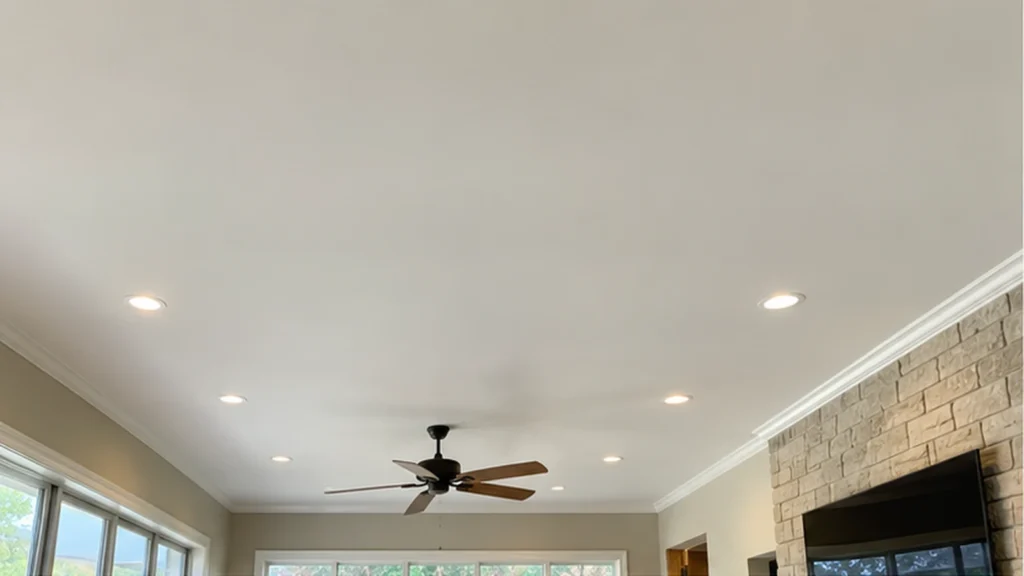
Smooth drywall has no decorative raised pattern. Its uninterrupted appearance suits contemporary rooms, recessed lighting, and changing decor. Cleaning is straightforward, but joints, roller marks, and uneven finishing become obvious in strong side lighting.
Quality preparation and low-sheen paint help. Demanding light conditions may justify higher-level finishing.
Best for: Modern living rooms, kitchens, bedrooms, and low-maintenance interiors.
2. Knockdown Ceiling Texture
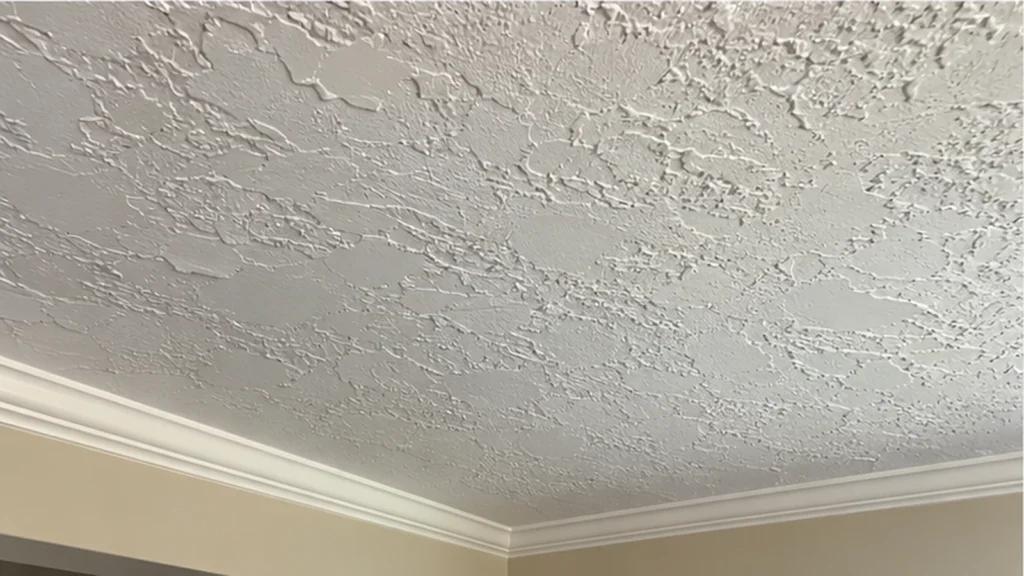
Knockdown features irregular patches made by spraying compound and flattening raised peaks at the appropriate stage. Fine applications look restrained; coarse patterns feel rustic.
It disguises minor cosmetic irregularities, though matching patch size and density during repairs requires practice. Texture cannot fix damage beneath drywall.
Best for: Family rooms, bedrooms, and hallways requiring moderate surface detail.
3. Orange Peel Ceiling Texture
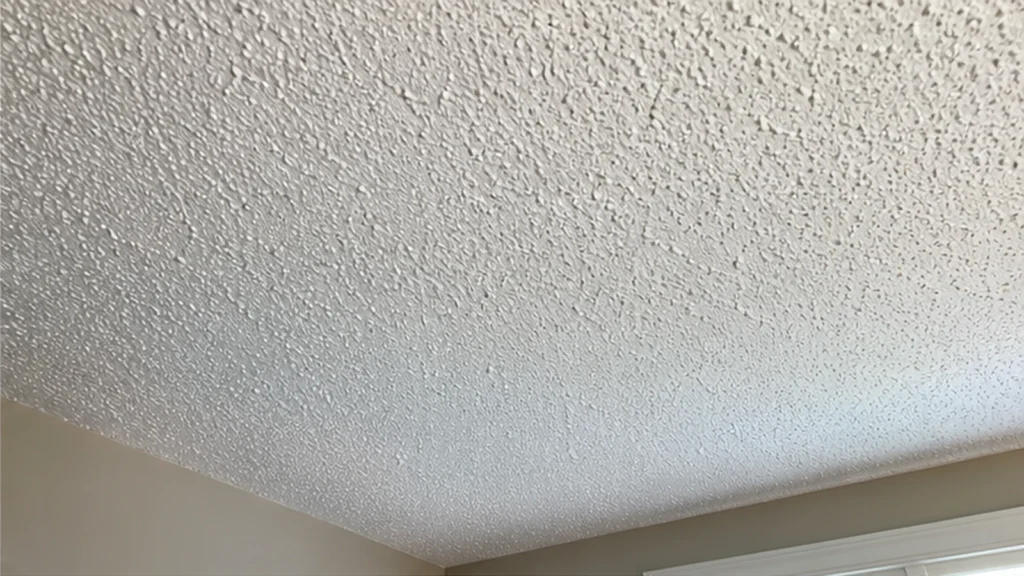
Orange peel resembles small rounded dimples. Sprayed droplets remain raised rather than flattened, creating subtler relief than knockdown.
Uniform spray settings are essential; repairs must match the original dimple size and density. Compatible aerosol products may help with small, safe patches.
Best for: Apartments, bedrooms, hallways, and understated contemporary interiors.
4. Skip Trowel Ceiling Texture
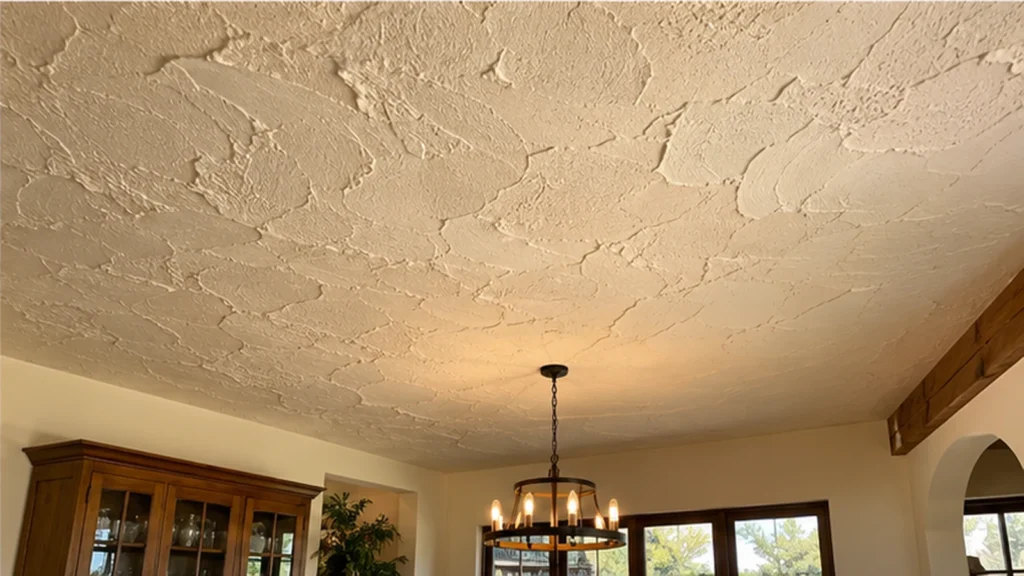
A trowel skips across wet compound, forming irregular plaster-like patches separated by smoother areas. Light skip trowel complements timber, stone, and warm colors; heavy application creates stronger visual texture.
Its handcrafted character requires skill, and exact repairs are difficult across large surfaces.
Best for: Rustic, Mediterranean, and Spanish-inspired rooms.
5. Slap Brush Ceiling Texture
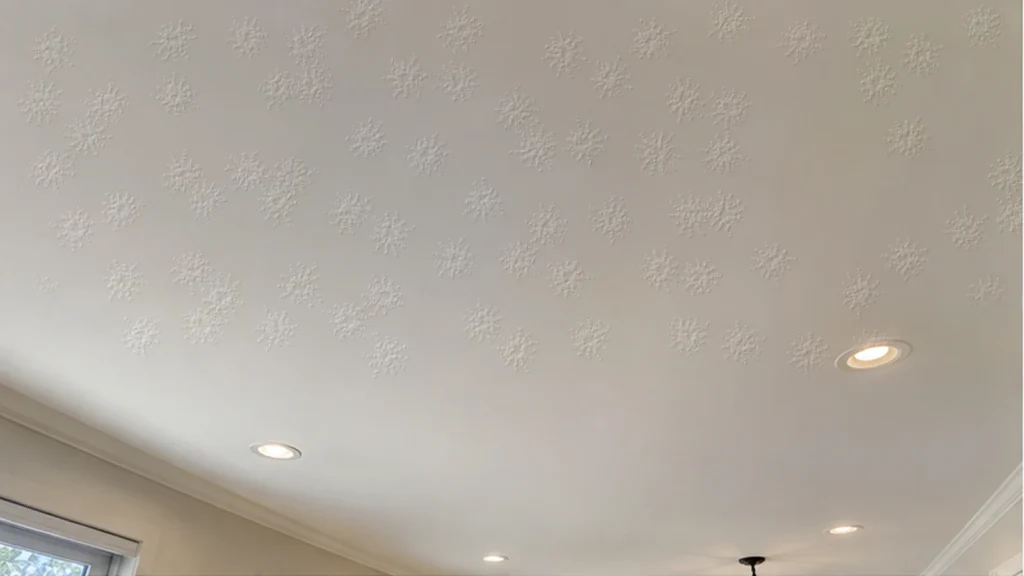
Slap brush, or stomp, uses a textured brush pressed against wet compound, leaving overlapping floral or starburst impressions.
The technique avoids specialized spray equipment, but overhead stamping is tiring and consistency takes practice. Matching existing texture may require the original brush shape.
Best for: Traditional rooms and existing stomp-texture repairs.
6. Crow’s Foot Ceiling Texture
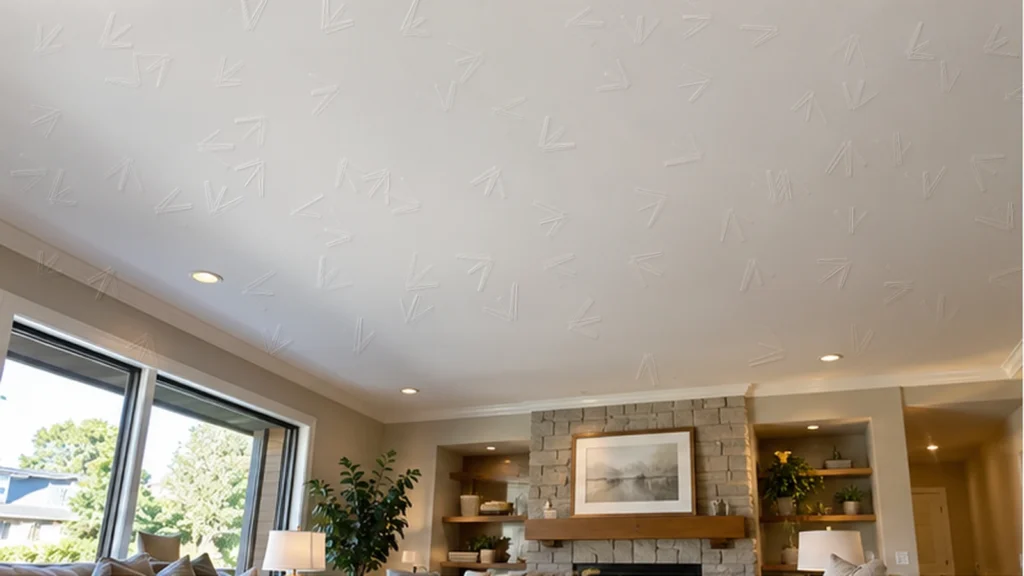
Crow’s foot creates branching, fan-shaped marks using a specialized stomp brush. Brush rotation, spacing, and compound thickness affect the appearance.
Dense marks can overwhelm small rooms and trap dust. Repairs need a closely matched brush pattern.
Best for: Traditional bedrooms and restoration work.
7. Swirl Ceiling Texture
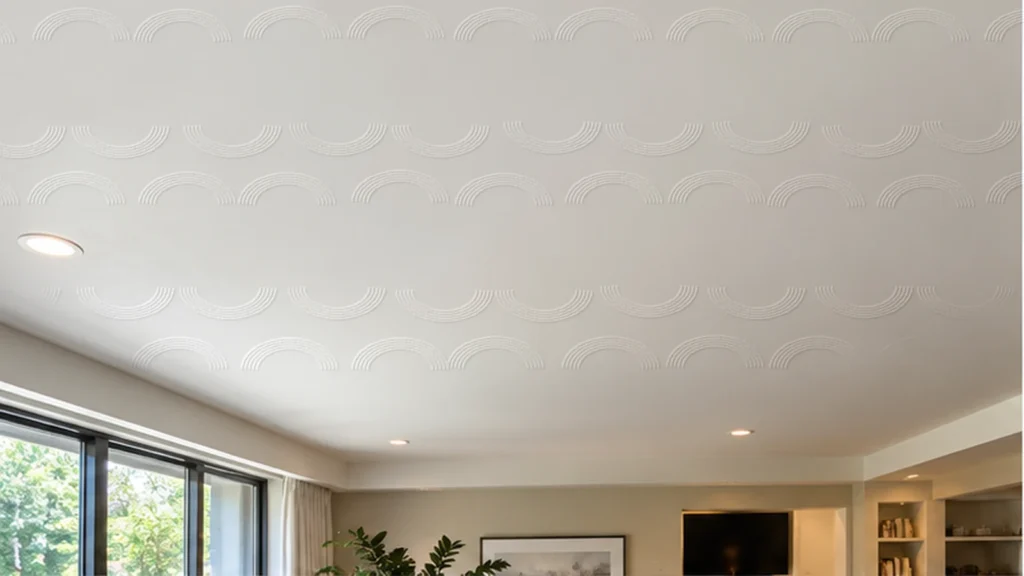
Swirl features repeating curves or semicircles formed with a brush, sponge, or trowel. It provides decorative movement without additional trim.
Spacing and transitions around lights need planning. Repairs are challenging because the arcs must connect to the original design.
Best for: Traditional dining rooms and decorative bedrooms.
8. Comb Ceiling Texture
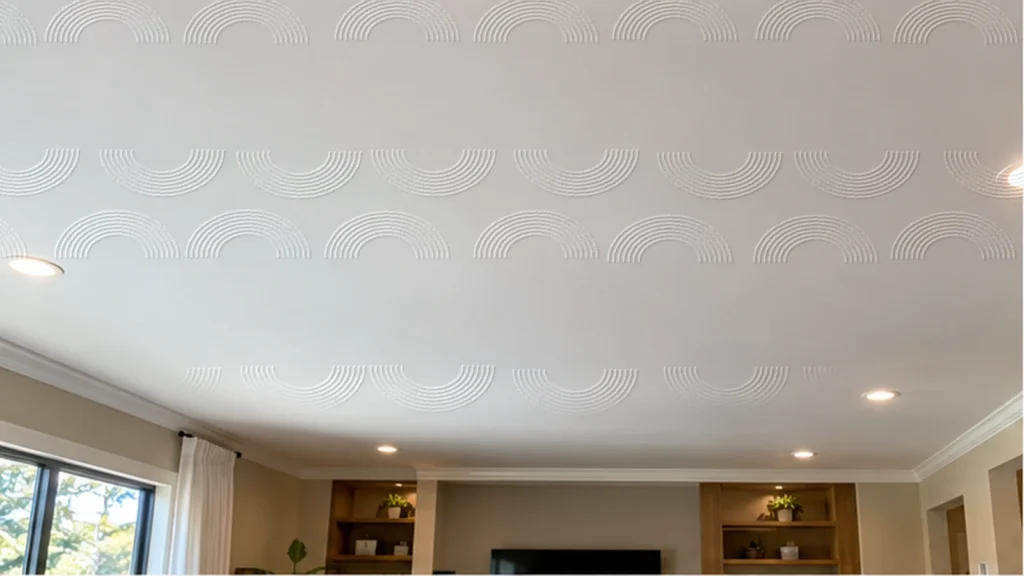
A toothed tool cuts straight grooves, arches, or repeating geometric shapes into wet compound. Comb texture suits selected Art Deco-inspired and statement interiors.
Uneven spacing is obvious, grooves collect dust, and repairs require careful pattern alignment.
Best for: Accent ceilings with otherwise simple decor.
9. Spray Sand Ceiling Texture
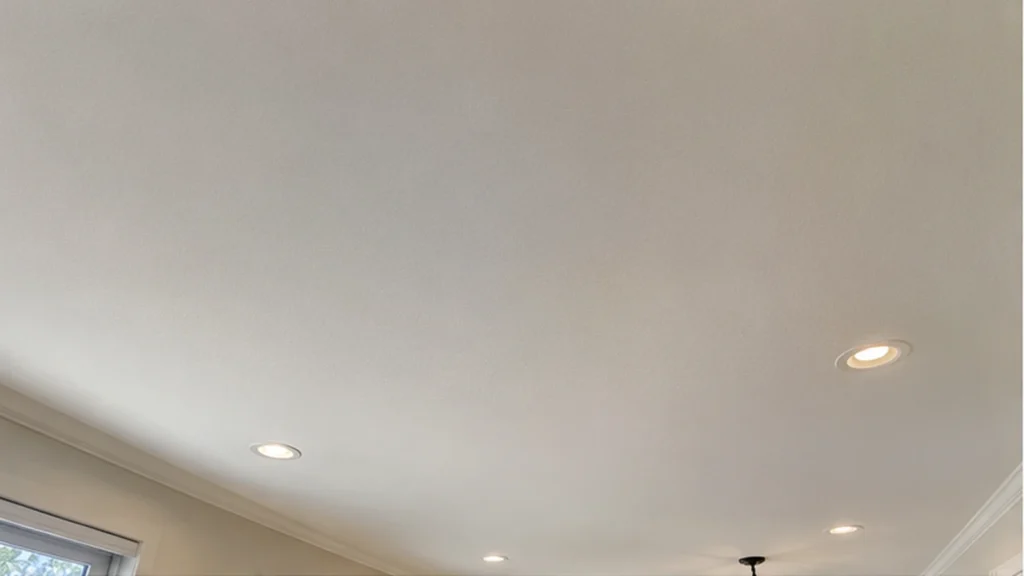
Spray sand contains fine aggregate that produces grain rather than orange peel’s rounded dimples. The effect can be restrained, but the product and aggregate size determine its appearance.
It is harder to clean than smooth drywall, and repair grain sizes can differ.
Best for: Hallways and lightly textured traditional spaces.
10. Lace Ceiling Texture
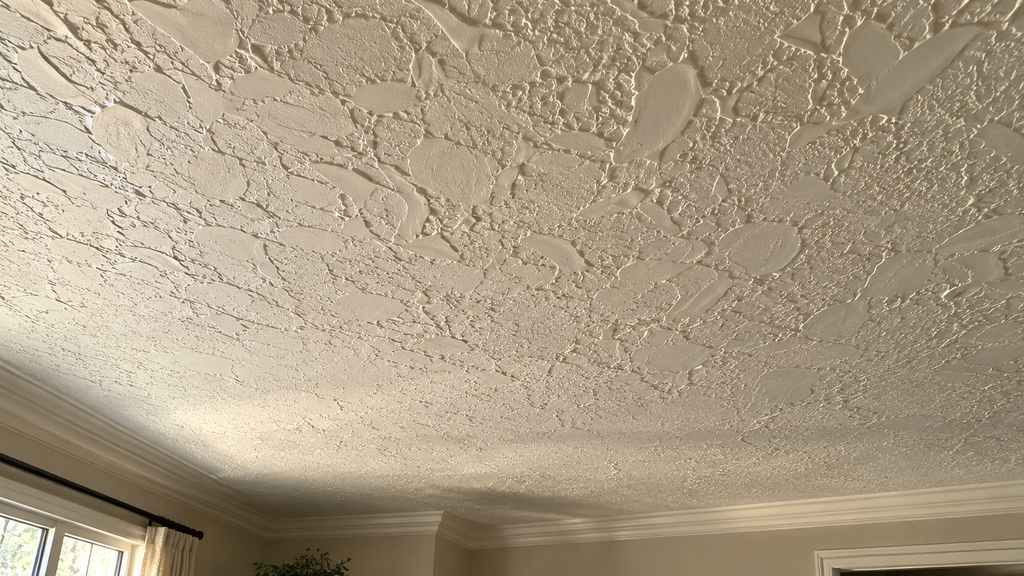
Lace creates intricate overlapping splatter through layered application and partial flattening. It resembles elaborate knockdown and complements decorative molding.
Heavy relief creates pronounced shadows and demands more cleaning. Repair blending is difficult.
Best for: Traditional sitting rooms and formal decorative interiors.
11. Hawk-and-Trowel Ceiling Texture
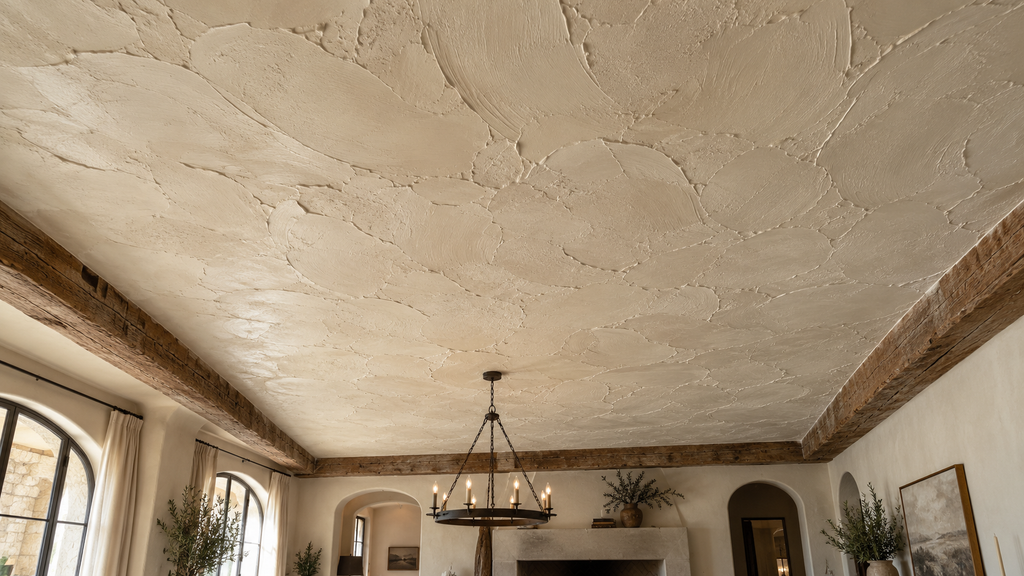
Using a hawk to hold compound, the finisher shapes broad strokes and irregular relief with a trowel. Its artisan-plaster appearance pairs well with stone and timber.
The pattern depends on specialist hand technique, increasing installation and repair demands.
Best for: Rustic and Mediterranean interiors.
12. Popcorn Ceiling Texture
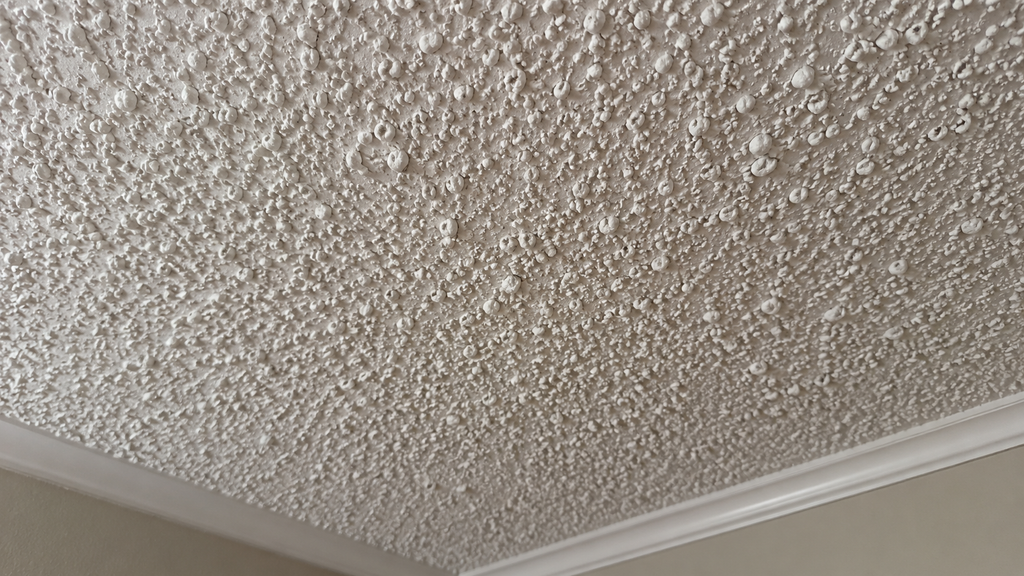
Popcorn has coarse raised clusters that conceal some cosmetic imperfections but trap dust and can become fragile. It is most familiar in older homes.
Some historical popcorn coatings contain asbestos, which cannot be identified visually. Do not scrape, sand, or drill into suspect finishes before qualified assessment. Preserving an intact older ceiling may be preferable to unnecessary disturbance.
Best for: Matching existing safe finishes.
What Are Other Common Ceiling Texture Names and Patterns?
Names often overlap across regions. Rosebud describes flower-like stamps; Santa Fe is a low-relief skip-trowel variation; sand swirl combines curves and grain; Spanish lace describes elaborate splatter. Stipple, stomp, and slap brush may indicate related techniques. Artex refers to decorative coatings associated with the UK, not one pattern or proof of safety. Supply photographs when requesting repairs.
Do Textured Ceilings Reduce Noise or Soundproof a Room?
Ordinary decorative texture does not reliably soundproof a room. Sound absorption reduces echo; isolation limits transmission between spaces. NRC describes tested absorption, while CAC is relevant to sound blocking through shared plenums in applicable systems. Footsteps from above usually require a floor-ceiling assembly solution, not new orange peel or knockdown. Choose acoustic products using documented performance.
Which Ceiling Texture Is Most Popular?
Knockdown and orange peel are familiar in North America, while smooth ceilings suit contemporary interiors. No reliable global ranking identifies one winner. Compare smooth for easy cleaning, orange peel for restrained detail, and knockdown for more relief, accounting for local building practices.
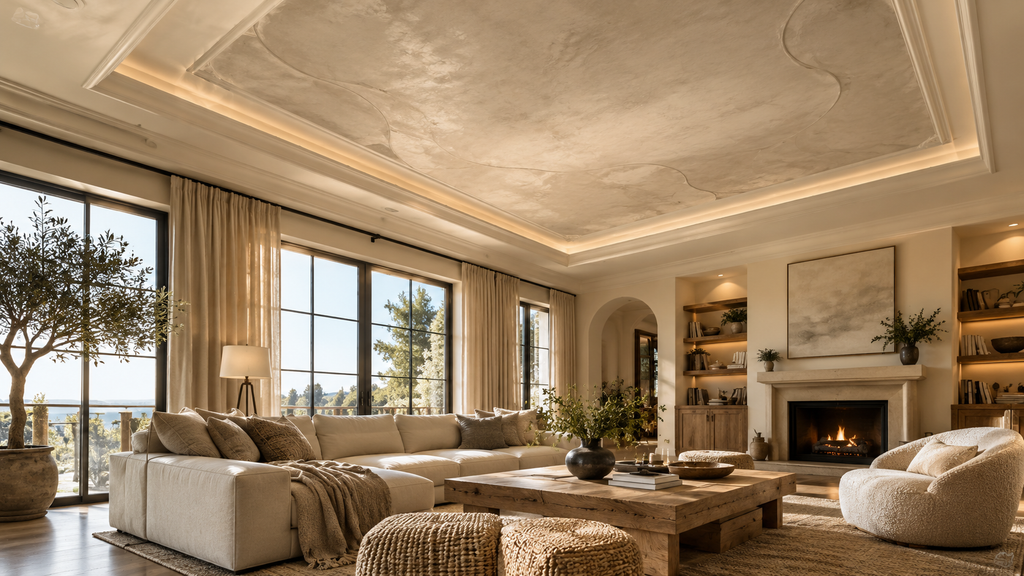
What Ceiling Textures Are Trending in 2026?
Design directions include warm smooth ceilings, subtle artisan plaster, natural wood, coordinated colors, and restrained molding. Cream, ivory, and beige complement low-sheen finishes; light skip trowel adds handcrafted character.
Wood slats, wallpaper, tray ceilings, and color drenching are ceiling treatments, not drywall textures. Test color and surface samples in daylight and evening lighting before committing.
Are Textured Ceilings Outdated in 2026?
No. Fine orange peel, light knockdown, and subtle plaster can look contemporary. Heavy popcorn and pronounced brush patterns may appear dated in certain homes, but sound historic finishes can remain appropriate. Renovate for genuine aesthetic or maintenance benefits, not simply to follow a trend.
How Do You Identify Ceiling Textures?
Examine the surface under side lighting. Rounded dimples suggest orange peel; flattened islands indicate knockdown; coarse clusters resemble popcorn. Fan-shaped marks indicate crow’s foot, arcs indicate swirl, and parallel grooves indicate comb. Skip trowel has scattered plaster patches; hawk-and-trowel features broad strokes.
Photograph close-up and wider views, including undamaged surroundings. Never scrape older coatings merely to identify them.
Which Ceiling Texture Is Best for Each Room?
| Room | Practical starting choice | Reason |
|---|---|---|
| Living room | Smooth or light knockdown | Calm appearance or moderate relief |
| Bedroom | Smooth or fine orange peel | Minimal visual distraction |
| Kitchen | Smooth | Easier removal of cooking residue |
| Bathroom | Smooth, with suitable system | Cleaning and moisture management |
| Dining room | Smooth or skip trowel | Modern or handcrafted character |
| Hallway | Fine orange peel | Subtle surface detail |
| Traditional family room | Knockdown or swirl | Decorative compatibility |
Bathrooms require suitable moisture-resistant systems and ventilation. Low ceilings benefit from restrained patterns; connected rooms often look cohesive with matching finishes.
What Materials Create Ceiling Textures?
Compatible drywall joint compound creates skip trowel, swirl, and slap brush finishes; spray products create orange peel and knockdown. Decorative plaster supports specialty work; aggregate coatings produce sand-like or popcorn patterns. Textured paint offers shallower relief.
Check approved substrates, thickness, mixing, drying, and overpainting requirements. Not every wall product suits overhead installation or humid environments.
Which Paint Finish Is Best for Ceilings?
Flat and matte paints minimize glare and soften minor variations. Eggshell and satin can be more reflective, revealing seams or roller marks. Where cleaning matters, choose an appropriate washable product rather than assuming all matte paints are washable. Prime raw texture when required and follow manufacturer instructions.
What Is a Level 5 Drywall Finish?
Level 5 gypsum-board finishing adds a full-surface skim coat or approved equivalent to specified joint treatment. It helps achieve uniform appearance under critical side lighting or demanding decoration. Level 4 serves many ordinary painted ceilings.
Level 5 costs more and cannot correct uneven framing. The Gypsum Association’s GA-214-2026 explains finish-level terminology; specify the intended appearance and lighting before work begins.
How Can Beginners Texture a Ceiling?
Start with sound, safely accessible drywall and practice on spare board before working overhead. A brush-applied pattern is often more approachable than a large sprayed knockdown ceiling.
- Inspect and protect: Check for leaks, sagging, loose tape, or suspect older coatings. Resolve defects and cover floors and furniture.
- Choose tools: Slap brush needs an appropriate brush and roller; skip trowel needs a finishing trowel; orange peel needs compatible spray equipment.
- Prepare: Repair joints, clean the surface, and prime where the product requires it.
- Mix correctly: Follow the manufacturer’s directions; mixtures that are too thin or thick produce inconsistent coverage.
- Practice: Try a roughly 24 × 24-inch sample, let it dry, and inspect the pattern under side lighting.
- Apply consistently: Work in manageable sections, maintaining the same pressure, movement, or spray settings.
- Finish the pattern: Flatten knockdown peaks only at the appropriate stage; there is no universal waiting time.
- Dry and paint: Observe product drying requirements, then prime and apply compatible ceiling paint.
Use appropriate protective equipment and stable overhead access. Never disturb suspected asbestos-containing material as a practice project.
Should You Texture a Ceiling Yourself or Hire a Professional?
DIY may suit a small hand-textured ceiling or minor repair on safe, sound material. Professionals are preferable for large knockdown areas, complex lace or comb patterns, vaulted ceilings, and difficult texture matching. Sagging, ongoing moisture damage, or suspected asbestos needs qualified assessment before work. Overhead consistency is more demanding than a practice sample.
How Do You Match Ceiling Texture?
First compare the original pattern’s shape, size, spacing, depth, and paint sheen. Reproduce it on a test board using a compatible material and tool. For orange peel, match droplet size and density; for knockdown, match sprayed patch size and flattening. Brush textures may require a similar brush.
Repair underlying damage, blend boundaries, allow the patch to dry, and prime before painting. A matching pattern can still look different if the surrounding paint has aged. Repainting the whole ceiling plane may produce a more uniform finish. Sound ceilings with only faded paint may need repainting, not replacement; recurrent stains or sagging require investigation first.
Which Ceiling Material Is Best?
Gypsum board supports seamless paintable surfaces. Plaster of Paris suits ornamentation; approved PVC panels may offer easier cleaning in selected settings; WPC provides wood-look finishes. Timber, metal, and mineral-fiber systems serve other design needs.
These are materials, not texture patterns. Compare moisture limits, fire ratings, weight, fixings, and local approvals. USG, Knauf, and Gyproc supply gypsum-related products, but suitability matters more than branding.
What Are the Main Ceiling Designs?
Flat ceilings are level; tray ceilings have stepped heights; coffered ceilings feature recessed panels. Vaulted and cathedral styles rise toward roof geometry; suspended ceilings hang below structural surfaces and may conceal services.
Design differs from texture: a tray ceiling can be smooth, while a flat ceiling can have knockdown. Consider room height, construction, and budget before choosing elaborate forms.
How Much Does Ceiling Texture Cost?
Illustrative U.S. basic-texturing estimates are $1–$2 per square foot, with some knockdown work around $1–$2.50. Surface repairs, old texture removal, high ceilings, primers, painting, and complex handwork can add significantly.
For a flat 12 × 15-foot room, the area is 180 square feet. At $1–$2 per square foot, basic texturing would be approximately $180–$360, excluding possible extras. Obtain local quotes that identify preparation, material, finish, access, painting, cleanup, and specialist safety work. A premium smooth finish may cost more than basic spray texture if extensive skim coating is required.
How Can You Cover a Ceiling Without Plaster?
Appropriate gypsum board, timber, ceiling tiles, and approved PVC or WPC panels can cover an existing ceiling. Check load, fixings, fire requirements, and moisture exposure. Skim coating can be simpler on stable, compatible surfaces. Never conceal active leaks, unsafe supports, or suspected hazardous coatings beneath new panels.
Can You Apply New Texture Over Existing Texture?
Sometimes, but only when the existing coating is sound, securely bonded, dry, and compatible. Deep comb, heavy knockdown, or popcorn relief may show through a fine new finish. Added weight, adhesion, and moisture conditions also matter. Have suspect older coatings assessed before any disturbing preparation. For a flat appearance, resurfacing may work better than adding texture.
How Can You Improve a Ceiling on a Budget?
Keep sound existing materials, repair visible defects, and repaint consistently. Matte warm-neutral colors reduce glare; modest molding and coordinated wall colors may refresh the room. Lighting affects how flaws appear. Prioritize safe preparation and durable coatings over decorative panels that unnecessarily reduce height.
What Ceiling Texture Mistakes Should You Avoid?
Do not texture over moisture damage, loose coatings, or significant cracks. Other common errors include over-thick compound, unsuitable products, skipping the test panel, inconsistent spraying, and painting before the coating dries. A decorative finish cannot repair framing, prevent leaks, or restore failed drywall.
If orange peel looks uneven, check spray distance, settings, and mixture consistency. Smeared knockdown may have been flattened too early or too forcefully. Peeling suggests moisture, contamination, or adhesion failure; recurring cracks warrant investigation. Stop DIY work when the ceiling sags, large areas separate, leaks continue, or hazardous older materials are suspected.
How Do You Choose the Best Ceiling Texture?
Choose smooth for clean lines and easy cleaning, fine orange peel for understated detail, or light knockdown for greater relief. Use skip trowel, swirl, and elaborate patterns where architecture and maintenance needs justify them.
Inspect the existing ceiling, address hazards, compare samples under actual lighting, and obtain full installed quotations. Practical durability matters more than trends.
Frequently Asked Questions About Ceiling Textures
1. What Are the Different Types of Ceiling Textures?
Common choices include orange peel, knockdown, skip trowel, slap brush, crow’s foot, swirl, comb, spray sand, lace, hawk-and-trowel, and popcorn. Smooth is an untextured alternative.
2. What Is the Most Popular Ceiling Texture in 2026?
Knockdown and orange peel are familiar in North American homes; smooth is popular for contemporary interiors. No verified worldwide leader exists.
3. What Is the Most Modern Ceiling Texture?
Smooth matte ceilings offer a minimalist look. Fine orange peel and understated plaster effects also work in modern rooms.
4. What Are the Ceiling Texture Trends for 2026?
Warm smooth finishes, subtle plaster, natural wood, coordinated ceiling colors, and decorative molding are notable design directions.
5. Are Textured Ceilings Outdated in 2026?
Not universally. Subtle textures remain relevant; coarse patterns may look dated depending on the room and architecture.
6. Is Knockdown Better Than Orange Peel?
Knockdown creates more relief and hides some cosmetic irregularities. Orange peel is subtler and often easier to integrate into modern spaces.
7. Which Ceiling Texture Hides Imperfections Best?
Knockdown, skip trowel, and stamped textures can disguise minor surface flaws, but none fixes moisture or structural damage.
8. What Is the Easiest Ceiling Texture for Beginners?
Slap brush can be approachable with simple hand tools, provided you practice and the ceiling is safe and sound.
9. What Material Is Used to Texture Ceilings?
Drywall joint compound, specialized spray texture, decorative plaster, and aggregate coatings are commonly used, depending on the pattern.
10. How Can You Identify Ceiling Texture?
Use side lighting: dimples indicate orange peel, flattened patches suggest knockdown, and coarse clusters resemble popcorn.
11. How Do You Match Existing Ceiling Texture?
Match pattern size, density, depth, tools, and paint sheen. Test first, then blend and prime the repair.
12. Can You Paint Over a Textured Ceiling?
Yes, when the coating is stable and compatible. Follow product requirements and avoid disturbing potentially hazardous material.
13. Can You Apply New Texture Over Existing Texture?
Only when the original finish is securely bonded, dry, safe, and compatible with the proposed system.
14. Can You Make a Textured Ceiling Smooth Without Removing It?
Sometimes. Compatible skim coating or properly supported overboarding may work on suitable existing ceilings after assessment.
15. Do All Popcorn Ceilings Contain Asbestos?
No. Some historical coatings do, and appearance cannot confirm their composition. Seek professional assessment before disturbance.
16. Do Textured Ceilings Reduce Noise?
Decorative texture is not reliable soundproofing. Use tested acoustic products or assemblies for noise-control goals.
17. Which Ceiling Texture Is Best for a Bathroom or Kitchen?
Smooth, cleanable finishes on appropriate moisture-resistant systems are generally practical, alongside good ventilation.
18. How Much Does It Cost to Texture a Ceiling?
Illustrative U.S. basic-texturing estimates are approximately $1–$2 per square foot before possible repairs, painting, and other charges.
19. Which Is Better for Ceilings, PVC or Gypsum?
Gypsum offers seamless paintable finishes. Approved PVC panels may suit selected applications requiring moisture resistance and cleaning.
20. What Are the Three Main Types of Ceilings?
By construction, broad categories are directly attached, suspended, and exposed structural ceilings. Architectural styles use different classifications.
